When policymakers announce a tariff, the immediate image is simple: the government collects a fee at the border, importers grumble, and domestic producers breathe a sigh of relief. But the real story is messier, and it matters for consumers, workers, farmers, and exporters in ways that often surprise voters and journalists alike. In this article we’ll untangle the legal collection of tariffs from the economic incidence — in other words, figure out who actually pays a tariff? (It’s not who you think).
- Tariff basics: what a tariff is and how it shows up in prices
- Statutory incidence versus economic incidence
- Elasticity explained with an everyday image
- Small-country versus large-country tariffs
- Terms-of-trade gains and their limits
- Who ends up paying: consumers, producers, or foreign exporters?
- Distributional snapshot
- Measuring pass-through: how much of a tariff shows up in retail prices?
- Empirical example: recent studies on US tariffs
- Real-life example: the 2018 steel and aluminum tariffs
- Hidden costs: beyond the sticker price
- Tariffs, retaliation, and the wider economy
- Case study: agricultural exports and retaliation
- Tariffs as transfers: who wins and who loses politically?
- Who pays within households? Distributional fairness
- Supply chains and the modern economy
- Example: tariffs on electronics components
- Estimating incidence: practical steps economists use
- Simple checklist for analyzing a tariff’s incidence
- Winners and losers: beyond national aggregates
- Alternatives to tariffs for addressing trade concerns
- How tariffs interact with other trade policies
- International distribution: how exporters feel the heat
- Marketplace adjustments and long-run effects
- Practical table: incidence under simple scenarios
- Policy implications: what should governments consider?
- Practical advice for consumers and firms
- Closing reflections: tariffs are a tax with a story
Tariff basics: what a tariff is and how it shows up in prices
A tariff is a tax on imported goods, most commonly applied as a specific sum per physical unit or as an ad valorem charge, a percentage of the shipment’s value. The tariff is legally levied on goods crossing the border, and customs authorities typically require importers to pay it when goods enter the country; that’s the statutory incidence, the formal assignment of responsibility for payment.
But the statutory incidence is only one layer. Prices in markets adjust to taxes in ways determined by supply and demand, transportation costs, and market power. How these adjustments happen — who ends up with lower incomes or higher prices — is the economic incidence, and this is the key to understanding who truly bears the burden of a tariff.
Statutory incidence versus economic incidence
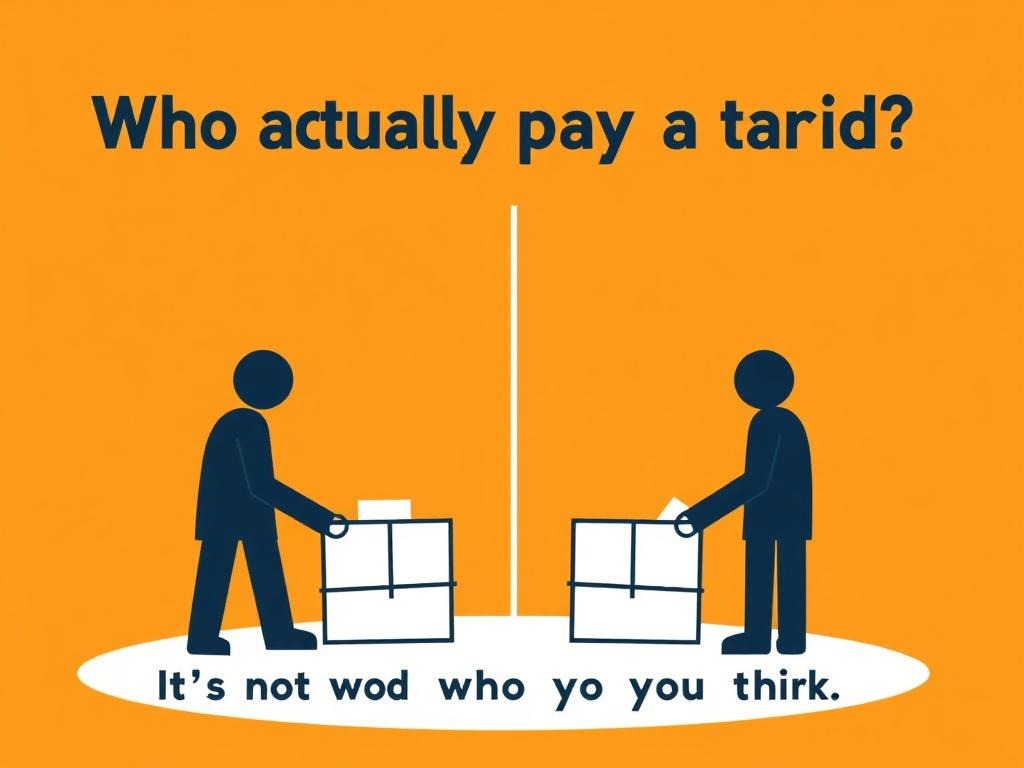
When the law says the importer pays the tariff, many assume the importer bears the cost. In practice importers act like merchants: they set prices to cover costs, compete for market share, and seek profit. If an importer can pass the added cost along, consumers will pay via higher retail prices; if not, the importer or foreign exporter may absorb some of the hit.
Economic incidence is determined by relative elasticities: the responsiveness of buyers and sellers to price changes. If buyers are insensitive to price (inelastic demand) they will shoulder most of the tariff through higher prices. If sellers — often foreign suppliers — have little ability to reduce exports or change markets, they may accept a lower net price and shoulder more of the tariff’s burden.
Elasticity explained with an everyday image
Think of supply and demand as two ropes pulling on price. If consumers are tightly gripped to the rope (inelastic demand), a tariff pulls the price up near their end. If suppliers hold fast (inelastic supply), their net receipts fall. The tug of war determines who loosens the most — and who effectively pays the tax.
This rope metaphor helps explain why a tariff on a luxury imported handbag will be mostly paid by wealthier buyers who choose the product despite higher prices, while a tariff on a staple commodity might hit consumers harder because they have few substitutes.
Small-country versus large-country tariffs
The international context matters. For a small country that takes world prices as given, imposing a tariff doesn’t change the world price, so the domestic price rises by roughly the full amount of the tariff (minus any small adjustments), and domestic consumers pay most of the cost. Exporters outside the country receive the same world price and do not benefit or lose from the tariff beyond reduced exports.
For a large country whose tariffs can affect world prices, the situation changes. A tariff can lower the world price by reducing foreign demand for the good, improving the imposing country’s “terms of trade.” In effect, the country can shift some of the burden onto foreign producers: the world price falls, so foreign exporters receive less, and some of the tariff cost is absorbed abroad.
Terms-of-trade gains and their limits
A large country can theoretically gain from a tariff if the terms-of-trade effect sufficiently lowers export prices abroad. That gain comes in the form of cheaper imports relative to exports, which can offset producer harm at home. But these gains are constrained: retaliation, incomplete pass-through, and political costs often erode any net benefit.
Moreover, terms-of-trade gains represent transfers rather than efficiency improvements. They redistribute income but create deadweight losses in the domestic economy, so the overall welfare picture is mixed and depends on the size of the tariff and the structure of markets.
Who ends up paying: consumers, producers, or foreign exporters?
In the simplest textbook case, a tariff creates four main effects: higher domestic prices, lower quantity consumed, increased domestic production, and reduced imports. Consumers lose because they pay higher prices and buy less. Domestic producers who face less foreign competition gain from higher prices and increased sales.
Foreign exporters usually get squeezed because they face reduced quantities and sometimes lower net prices after the tariff; to keep market share they may cut their prices to absorb some of the tariff. The government collects revenue from the tariff, which is a transfer from the private sector to the public purse. How these pieces balance depends on market elasticities and the structure of the industry.
Distributional snapshot
Breaking it down broadly: consumers tend to lose, protected domestic producers gain, the government gains revenue, and foreign producers often lose some ground. The magnitude of each effect varies by product, market structure, and how firms react to price changes.
That distribution is why tariffs are often politically attractive: benefits concentrate on organized producer groups while losses disperse across many consumers, each of whom bears a small increase in prices that feels less salient at the ballot box.
Measuring pass-through: how much of a tariff shows up in retail prices?
Pass-through is the share of a tariff that is reflected in consumer prices. Empirical studies show pass-through varies enormously. For some goods, especially homogeneous commodities traded on global markets, pass-through can be near complete; consumers pay almost the full tariff-induced price increase. For differentiated goods sold by branded firms, pass-through might be partial as firms absorb some costs to preserve market share.
Pass-through depends on competition, supply chain costs, distribution margins, and exchange rates. A tariff that looks modest at the customs declaration can translate into a larger retail-price change once distributors, retailers, and taxes are layered on — or a smaller change if firms eat part of the tariff to stay competitive.
Empirical example: recent studies on US tariffs
When the United States imposed tariffs on certain imports from China in 2018–2019, researchers found that a substantial share of the tariff cost was passed onto U.S. consumers in higher prices for affected goods. The extent varied across products: tariffs on consumer electronics were largely absorbed by firms, while tariffs on simpler manufactured goods showed higher pass-through to consumer prices.
These findings reflect the heterogeneity of markets: brand power, global supply chain levers, and alternative sourcing options all influence how much of the tariff is felt at the cash register.
Real-life example: the 2018 steel and aluminum tariffs
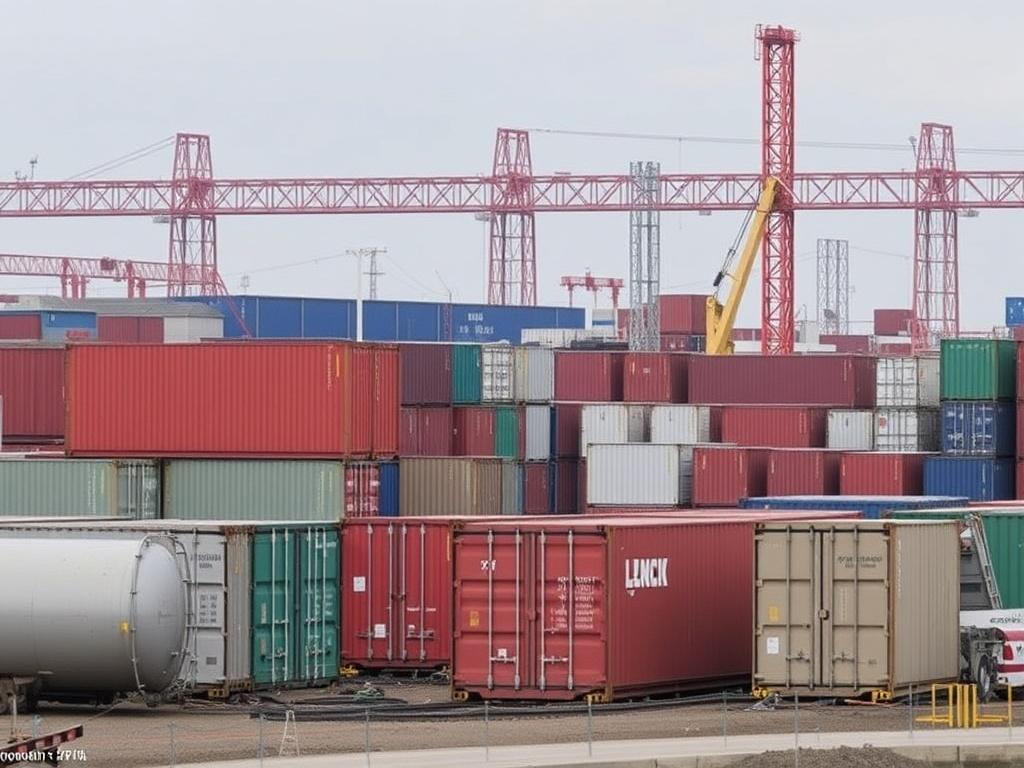
In 2018, the U.S. placed a 25 percent tariff on steel and a 10 percent tariff on aluminum imports. Steel-consuming industries, such as auto manufacturers, faced higher input costs. Some domestic steel producers benefited from higher prices and expanded production, but downstream manufacturers reported higher expenses and reduced competitiveness.
Analyses showed price increases for steel-intensive products and significant input-cost pressures across the supply chain. Job gains in protected domestic steel mills were often smaller than job losses in steel-using industries, illustrating that concentrated benefits can appear alongside broader dispersed harm.
Hidden costs: beyond the sticker price
Tariffs generate visible price changes, but they also produce less visible effects: slower innovation, inefficient resource allocation, and administrative expenses. Firms protected by tariffs may have less incentive to improve productivity, and domestic consumers pay with both higher prices and fewer choices. Customs enforcement and compliance create additional government and private-sector costs that don’t show up directly as tariff revenue.
Smuggling and evasion are other hidden costs. When tariffs raise profit opportunities for illegally imported goods, some trade shifts underground, reducing tariff revenue and creating enforcement burdens. The more distortionary a tariff, the greater the incentive for evasion tends to be.
Tariffs, retaliation, and the wider economy
Tariffs rarely exist in isolation. Targeted countries often respond with their own tariffs, which can harm exporters in the country that initiated the policy. Retaliation may hit sectors that were politically supportive of the tariff-imposing government, creating surprising losers in the short term and long term.
Retaliatory tariffs also spread the burden of trade disruption across industries. In some cases, a tariff aimed at protecting one sector ends up reducing exports in an unrelated sector because foreign governments decide to retaliate selectively to cause political pain.
Case study: agricultural exports and retaliation
When tariffs are retaliated against by targeting agricultural goods, the results are often stark because many farmers are highly export-dependent. Reduced market access abroad can lower commodity prices, harm farm incomes, and shift the tariff’s burden back onto domestic producers who were not the tariff’s original target.
This pattern illustrates how the initial distributional story can be reshaped by second-order policy responses, making the true incidence of tariffs a moving target influenced by geopolitical strategy, not just economics.
Tariffs as transfers: who wins and who loses politically?
The political economy of tariffs hinges on concentrated benefits and diffuse costs. Import-competing industries are often small and highly organized, making lobbying for protection effective. Consumers, who bear higher prices across many goods, are a large and unorganized group that may not perceive the cumulative cost of protectionist measures.
This political asymmetry helps explain why tariffs remain tempting for politicians: the benefits to a few visible groups can outweigh the less visible, widely distributed costs in electoral terms. Yet the macroeconomic costs — slower growth, higher consumer prices, and ineffective allocation of resources — can be substantial over time.
Who pays within households? Distributional fairness
Tariffs do not affect all households equally. Low-income families spend a larger share of their income on basic goods, so tariffs on staples disproportionately reduce their real purchasing power. High-income households are more likely to consume luxury imports, so they may bear tariffs aimed at such products, but the relative burden differs.
Understanding the household-level incidence requires looking at consumption patterns by income group. Policymakers who focus on equity should ask whether the protected industries’ gains justify the regressivity of many tariffs that raise costs for essential goods disproportionately consumed by lower-income households.
Supply chains and the modern economy
Global supply chains complicate the picture because many “imports” include intermediate inputs used to produce domestic goods. A tariff on an imported component raises costs for domestic manufacturers, which can erode competitiveness and push production decisions away from the tariff-imposing country. In short, tariffs can be self-defeating when applied to inputs of domestic industries.
For firms integrated across borders, tariffs act like a tax on domestic production. In my own experience consulting with manufacturers, I’ve seen firms accelerate offshore investment precisely to avoid recurring tariff exposure, shifting jobs and investment decisions away from the imposing country.
Example: tariffs on electronics components
A tariff on a small component in electronic devices may increase the final retail price by much more than the tariff itself because components are multiplied across many units and are critical to production. Manufacturers faced with persistent tariff uncertainty often redesign supply chains or move assembly to lower-cost jurisdictions, neutralizing the protectionist intent and harming domestic employment.
These responses underline that policymakers must map supply-chain interdependencies: a seemingly narrow tariff can have broad consequences through modern production networks.
Estimating incidence: practical steps economists use
Economists estimate incidence using a few standard tools: pass-through regressions that relate tariff changes to domestic price series, computable general equilibrium models that simulate whole-economy effects, and firm-level microdata that trace changes in import prices, quantities, and market shares. Each method has strengths and weaknesses depending on data availability and the complexity of markets.
Good empirical studies look for variation in tariff exposure across products and time, exploit natural experiments, and control for exchange rates, demand shocks, and input-cost changes. Combining methods delivers more robust inferences about who truly pays.
Simple checklist for analyzing a tariff’s incidence
- Identify the statutory payer and point of collection.
- Estimate demand and supply elasticities for the affected market.
- Assess whether the country is large enough to affect world prices.
- Consider supply-chain linkages and whether imports are intermediate inputs.
- Look for empirical evidence of pass-through to retail prices and producer receipts.
Winners and losers: beyond national aggregates
National statistics can hide sharp regional and sectoral effects. A tariff that modestly raises national consumer prices might protect a few regional industries, saving jobs in one area while costing jobs elsewhere. Local labor markets, industrial concentration, and the mobility of workers determine how costs and benefits are distributed geographically.
Policymakers often fail to account for these micro-level dislocations. Compensation policies—such as targeted transfers or retraining programs—can be used to offset concentrated losses, but such mechanisms are rarely sufficient or politically feasible at the necessary scale.
Alternatives to tariffs for addressing trade concerns
If the goal is to help workers or promote nascent industries, tariffs are a blunt instrument. Alternatives include targeted subsidies for innovation, wage insurance for displaced workers, investments in education, and sector-specific regulations that address unfair practices such as dumping or subsidies abroad. These approaches can be more efficient and less distortive than broad-based import taxes.
That said, legitimate concerns about national security or infant industry protection sometimes justify temporary tariffs, but they work best when narrowly tailored, time-limited, and accompanied by clear exit strategies to avoid becoming permanent inefficiencies.
How tariffs interact with other trade policies
Tariffs are only one tool among many: quotas, anti-dumping duties, countervailing duties, and regulatory standards all affect trade flows. The combined effect of these instruments determines the real cost of protection to consumers and producers. For example, a quota that limits import volume can raise prices more than a tariff because it restricts quantity directly.
Trade agreements and preferential tariffs also complicate incidence. Tariffs applied broadly across many trading partners affect world prices differently than tariffs targeted at a single country, and preferential regimes can shift who bears the burden by altering sourcing decisions.
International distribution: how exporters feel the heat
Exporters in countries facing tariffs often see reduced demand and downward pressure on prices. For commodity exporters with limited alternative markets, tariffs can be especially painful, lowering incomes for producers and sometimes causing broader macroeconomic stress. In manufacturing, exporters may try to circumvent tariffs by localizing production or renegotiating contracts.
Exporters’ bargaining power and market diversification determine how much of the tariff they absorb. Large, diversified exporters may redirect shipments, while small producers heavily dependent on a single market may be forced to accept lower net prices, effectively paying part of the tariff.
Marketplace adjustments and long-run effects
In the long run, markets adjust. Consumers change preferences, firms invest in different technologies, and supply chains reorganize. Some industries may shrink permanently, while others expand. Over time, tariffs tend to entrench inefficiencies when protection prevents struggling domestic firms from modernizing or merging with more efficient competitors abroad.
Long-run adjustments also mean that the ultimate incidence of a tariff can differ from its short-run impact. Initial consumer price hikes might give way to industry relocation or technological change that reshapes who benefits and who pays over a decade.
Practical table: incidence under simple scenarios
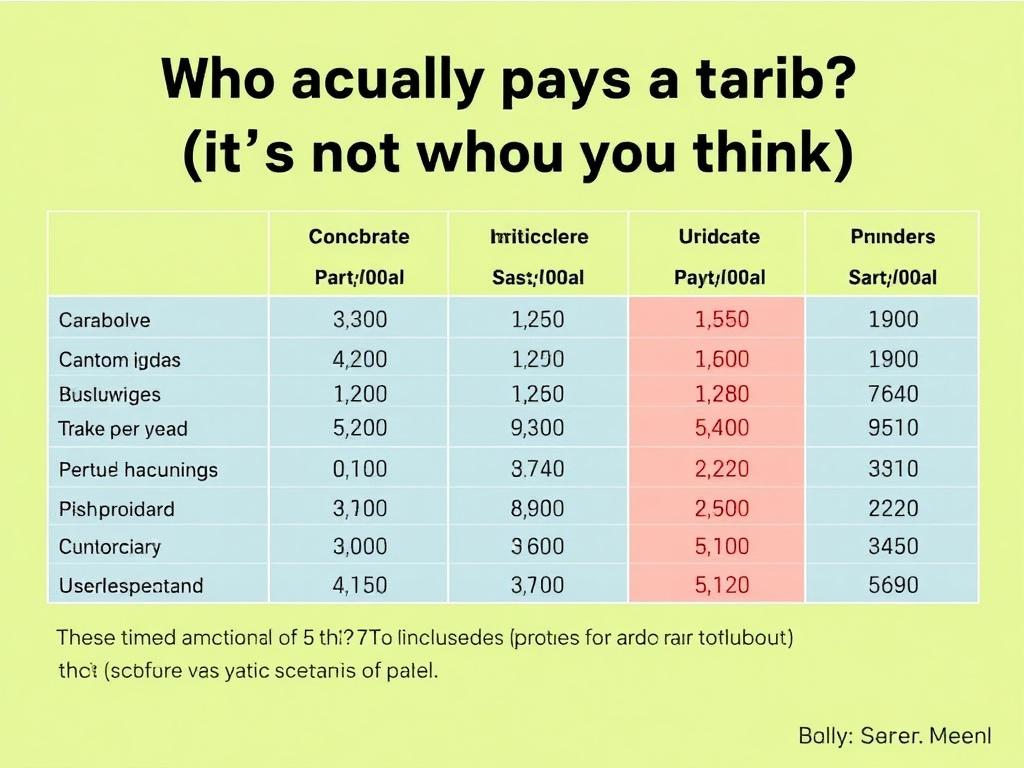
| Scenario | Dominant incidence | Short explanation |
|---|---|---|
| Small country, elastic demand | Foreign exporters and importers | Consumers switch to substitutes; foreign suppliers lower prices to retain market share. |
| Small country, inelastic demand | Domestic consumers | Consumers pay higher prices since substitutes are limited. |
| Large country, significant market power | Foreign producers (terms-of-trade effect) | World price falls; some of the tariff is absorbed abroad. |
| Tariff on intermediate inputs | Domestic producers (consumers of inputs) | Input costs rise, making downstream firms less competitive. |
| Tariff on highly differentiated luxury goods | Wealthier consumers and brand owners | Brands may absorb part of the cost; affluent buyers still purchase at higher prices. |
Policy implications: what should governments consider?
Policymakers should analyze tariffs through the lens of economic incidence, not just statutory incidence. Understanding who ultimately bears the burden helps design mitigation measures, anticipate retaliation, and evaluate whether the protection is worth the cost. Transparent impact assessments can make tariff debates more evidence-based and less politically driven.
Compensation for adversely affected groups, sunset clauses on protection, and trade adjustment assistance are practical ways to address negative distributional effects. Ultimately, the best trade policies combine economic analysis with political realism to avoid unintended damage to consumers and downstream industries.
Practical advice for consumers and firms
Consumers can reduce exposure to tariff-driven price increases by substituting toward untaxed or domestically produced alternatives where feasible, shopping across retailers for better deals, and supporting policies that improve competition. Firms should map supply chains, diversify sourcing, and quantify tariff exposure to make informed procurement and investment choices.
For businesses, the key is preparation and flexibility: real-time monitoring of trade policy developments, scenario planning, and investment in relationships and logistics that reduce vulnerability to abrupt tariff changes have tangible payoffs.
Closing reflections: tariffs are a tax with a story
Tariffs are often portrayed as a straightforward tool: raise revenue and protect domestic jobs. In reality, they are a tax with a story — one that runs through retail prices, producer receipts, international markets, and political incentives. Who actually pays a tariff? The answer depends on a web of elasticities, market structures, and policy responses rather than on the simple label attached at the border.
Understanding that web matters for voters, businesses, and policymakers. If the goal is to support workers or foster new industries, more targeted, transparent, and economically informed tools generally outperform blunt tariffs. The sticker price on a box crossing a border tells only the first chapter; the rest of the tale plays out in households, factories, and markets across the country and around the world.