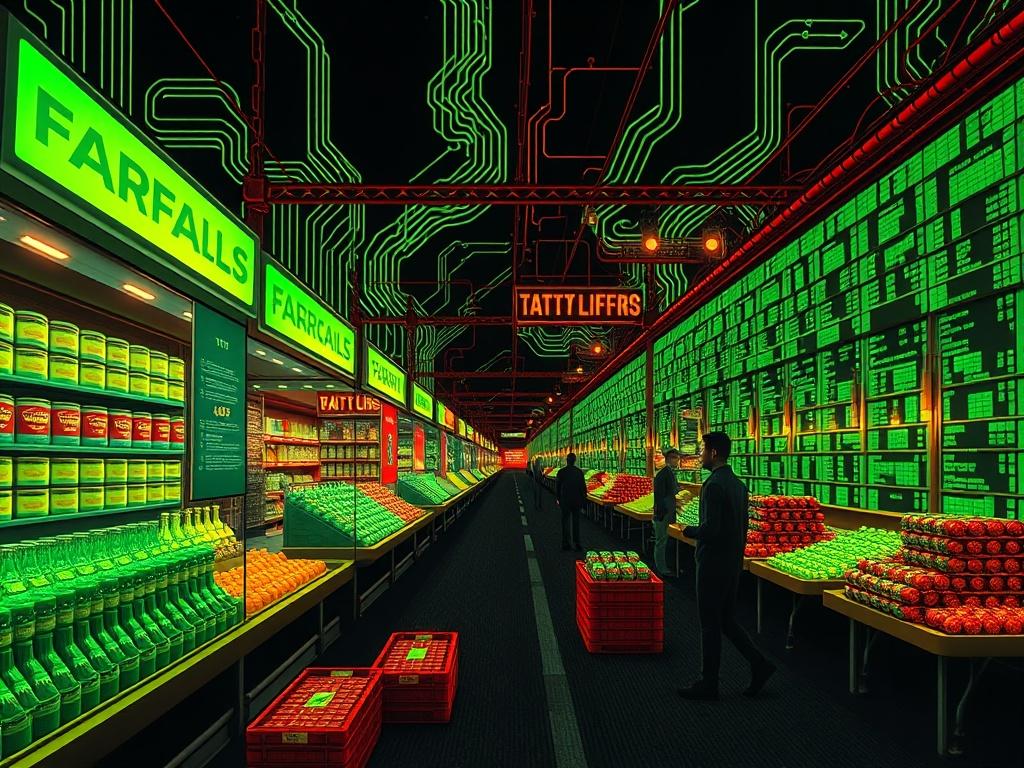
Imagine a world where machines print clothing on demand, solar panels shower every neighborhood with cheap energy, and atomically precise assemblers produce goods from ubiquitous feedstock. In that world, scarcity as we know it is largely gone: essentials are abundant, marginal costs approach zero, and markets look radically different. Yet even in such a future, governments and communities may find reasons to impose trade barriers, including tariffs, to steer outcomes, protect values, or manage new scarcities.
- What a post-scarcity economy really looks like
- Tariffs through history: why they mattered
- Why tariffs might persist in an age of abundance
- Managing residual physical scarcities
- Environmental and sustainability rationales
- Protecting data, culture, and intangible goods
- How tariffs would be designed in practice
- Types of border measures that could replace or complement tariffs
- Enforcement and verification in decentralized production networks
- Economic effects and distributional consequences
- Winners and losers
- Political economy and global governance
- Multilateralism versus unilateralism
- Technology, markets, and the new scarcity frontier
- Intellectual property, reputation, and regulatory arbitrage
- Scenario planning: three plausible futures
- Scenario A: cooperative abundance
- Scenario B: fragmented resilience
- Scenario C: contested scarcity
- Case studies and illustrative examples
- Space-mined platinum and terrestrial tariffs
- AI models, data flows, and digital border adjustments
- Local fabrication and provenance fees
- Legal and ethical considerations
- Human rights and access to essential goods
- Practical policy recommendations
- Modeling and measurement challenges
- Data, experiments, and iterative policy design
- Envisioning governance for a changing world
- Final thoughts on maneuvering through abundance
What a post-scarcity economy really looks like
“Post-scarcity” is often portrayed as utopian shorthand: everything you want is instantly available. The reality is more nuanced. A post-scarcity economy reduces scarcity for many goods and services thanks to automation, distributed manufacturing, and abundant energy, but it does not erase limits entirely.
Physical and ecological constraints persist. Rare elements, planetary carrying capacity, and unique human attention remain limited, and social inequalities can survive even when material goods are plentiful. Understanding these constraints helps explain why instruments like tariffs can retain a role.
Tariffs through history: why they mattered

Tariffs have long been tools of fiscal policy, protectionism, and diplomacy. Governments levied duties to raise revenue, shield nascent industries, or punish trading partners. Their effects depended on technology, transportation costs, and the structure of production.
Even in the 19th and 20th centuries, the impulse behind tariffs varied: safeguarding jobs, building industrial capacity, or securing strategic resources. Those motivations offer clues about how policymakers might think in a world where manufactured scarcity is greatly reduced.
Why tariffs might persist in an age of abundance
The immediate intuition is simple: if goods cost nearly nothing and production is ubiquitous, tariffs become irrelevant. But several rationales survive the abundance revolution. First, scarcity migrates to other dimensions—energy, rare materials, digital attention, and regulatory space—and tariffs can be repurposed to manage those scarcities.
Second, tariffs are political instruments. Leaders use them to shape domestic industry, influence social outcomes, or respond to voters’ concerns. Technological abundance changes the stakes but does not remove the incentives to tax or regulate cross-border flows.
Managing residual physical scarcities
Abundance in finished goods does not eliminate the need for raw materials. Elements like rare earths, platinum-group metals, and isotopes may remain localized and hard to substitute. Tariffs or import fees can help prioritize domestic access, fund recycling infrastructure, or steer conservation efforts.
Consider critical minerals for renewable infrastructure. Even with advanced recycling and material efficiency, bottlenecks may arise. A carefully designed tariff can discourage wasteful import patterns or raise revenues to invest in domestic extraction alternatives and circular supply chains.
Environmental and sustainability rationales
Environmental externalities become more visible when production is cheap. If manufacturing is inexpensive but ecologically damaging, governments can use border measures to internalize those costs. Tariffs can punish high-carbon imports or reward cleaner production practices.
Such measures reflect a shift from protecting domestic jobs to protecting planetary systems. They work best when paired with transparent standards and international cooperation; otherwise they risk becoming veiled protectionism rather than genuine climate policy.
Protecting data, culture, and intangible goods
As physical scarcity recedes, value migrates to intangibles: intellectual property, cultural content, and personal data. Nations may impose fees on cross-border flows of digital goods, or tariffs could evolve into digital border adjustments to reflect differing privacy regimes and cultural protections.
These new forms of trade friction are less about tonnage and more about norms. For example, a country might levy charges on foreign streaming services to support domestic cultural producers or to offset the costs of enforcing local data protection standards.
How tariffs would be designed in practice
Designing tariffs in a post-scarcity economy requires rethinking goals, instruments, and metrics. Traditional ad valorem tariffs (percentage of value) become awkward when goods have nominal or zero price. Policymakers would need alternative bases: per-unit fees, environmental impact levies, or resource-use surcharges.
Implementation complexity rises when production is distributed and digital. Customs agencies must trace origins through decentralized manufacturing networks, and enforcement hinges on standards rather than simple physical inspections. New administrative systems and technologies will be necessary.
Types of border measures that could replace or complement tariffs
- Resource-use tariffs: fees based on the amount of scarce input consumed.
- Carbon and environmental border adjustments: charges reflecting lifecycle emissions.
- Data transfer fees: levies on cross-border flows of monetized personal or proprietary data.
- Service-origin adjustments: surcharges tied to the jurisdiction where an AI or service provider is regulated.
These instruments broaden the concept of a tariff from taxes on goods to charges on the impacts and externalities associated with cross-border exchanges. They can be calibrated to policy aims rather than market prices.
Enforcement and verification in decentralized production networks
Enforcing import duties becomes a technological challenge when items are manufactured locally from shared blueprints. Traceability systems—blockchain-like registries, cryptographic provenance, or trusted certification schemes—may be required to determine whether a good is domestic or foreign in spirit.
Certification itself turns into a public good. Governments or multilateral institutions might accredit fabrication nodes and maintain registries to support compliance. These systems must balance privacy, trade facilitation, and fraud prevention.
Economic effects and distributional consequences
Even modest tariffs can distort behavior in surprising ways when marginal costs fall. A fee that was negligible on a $100 product becomes meaningful when the product’s price drops to near zero, altering consumption and production incentives. Policymakers must study elasticity and behavioral responses carefully.
More importantly, tariffs affect distribution. In a world where production is abundant, tariffs may serve primarily to redistribute value—funding universal services, supporting care infrastructure, or compensating those displaced by automation. The public finance role could eclipse the protectionist role.
Winners and losers
Tariffs that target environmental externalities might help communities suffering from legacy pollution. On the other hand, poorly designed tariffs could entrench incumbent data monopolies or raise costs for poorer consumers who rely on imported digital services. Equity analysis must be central to policy design.
Design should include transitional support for displaced workers and investment in public goods like education and health. When tariffs are used as revenue mechanisms, transparency about spending and safeguards against capture are crucial to maintain legitimacy.
Political economy and global governance
Trade policy is inherently political. Even if the economic rationale for tariffs shifts, the political drivers—interest groups, identity politics, and strategic rivalry—remain. Democracies will face pressure to use border measures to respond to voters’ concerns about fairness and security.
At the international level, existing institutions like the WTO would need to evolve. The legal vocabulary built around goods and services may not map neatly onto resource-use fees, data levies, or provenance-based measures. New treaties and norms will likely emerge.
Multilateralism versus unilateralism
Unilateral tariffs can provoke retaliation and fragmentation, but multilateral coordination is difficult when countries have asymmetric capabilities and priorities. Climate-aligned border adjustments may win allies, while data-related tariffs could spark ideological clashes over privacy and digital sovereignty.
Hybrid approaches—regional agreements on resource standards, plurilateral deals on data flows—are plausible stepping stones. They can reduce frictions while preserving policy space for nations to pursue distinct social goals.
Technology, markets, and the new scarcity frontier
Technological advances will shift where scarcity resides. Advances in materials science could democratize access to certain inputs, while breakthroughs in quantum materials or fusion might alter strategic calculations overnight. Tariffs must therefore be flexible and evidence-driven.
Markets will also morph. If most manufactured goods are free, scarcity will concentrate in attention markets, unique experiences, and reputation. Tariffs and border measures might target the distribution of these scarce experiences, although intervening in cultural markets raises thorny free-expression issues.
Intellectual property, reputation, and regulatory arbitrage
IP enforcement may become a core function of trade policy in an abundance economy. Countries could use fees to block or tax designs that violate domestic norms or to favor registered creators. These measures tread on delicate freedoms and require careful legal framing.
Regulatory arbitrage—firms locating data centers or fabrication nodes in permissive jurisdictions—will remain a challenge. Tariffs or border adjustments can be designed to reduce arbitrage by linking charges to consumers’ jurisdiction or to the site of value extraction rather than paper invoices.
Scenario planning: three plausible futures
Anticipating the long-term role of tariffs benefits from scenario thinking. Each scenario highlights different drivers and policy responses rather than predicting a single outcome. I’ve sketched scenarios in policy briefings and found that clarity about trade-offs helps stakeholders align on priorities.
Below are three condensed scenarios that illustrate how border measures might evolve under different assumptions about technology, cooperation, and politics.
Scenario A: cooperative abundance
In this optimistic path, multilateral cooperation adapts quickly. Countries agree on environmental and data standards, and harmonized border adjustments support a smooth transition to abundant production. Tariffs are modest, targeted, and used to fund global public goods like planetary monitoring and recycling networks.
This scenario minimizes trade friction and maximizes shared gains, but it requires strong institutions and trust. The key risk is that consensus breaks down when shocks reveal asymmetric vulnerabilities.
Scenario B: fragmented resilience
Here, states prioritize domestic resilience over cooperation. Tariffs and resource-use fees are widely used to ensure local access to critical inputs and to fund social cushions. Cross-border digital flows are taxed unevenly, leading to regulatory fragmentation and higher compliance costs for firms and consumers.
Economic efficiency declines relative to A, but some communities gain security and social protections. The trade-off is between short-term autonomy and long-term specialization gains from global integration.
Scenario C: contested scarcity
In the least cooperative scenario, geopolitical rivalry drives heavy-handed tariffs and export controls on key inputs. Resource hoarding, sanctions, and protectionist measures produce fragmented markets and hinder knowledge exchange. Innovation slows where collaboration is stifled, and black markets flourish.
This path illustrates the danger of weaponizing border measures: scarcity is artificially sustained to gain leverage, at considerable economic and ethical cost.
Case studies and illustrative examples
Concrete examples help ground abstract discussion. Consider three hypothetical but realistic situations that show how tariffs could be practical, problematic, or both in a high-abundance world.
Space-mined platinum and terrestrial tariffs
Suppose orbital miners begin returning platinum-group metals to Earth. Abundant supply depresses prices, but Earth-based industries are threatened by volatile market shifts. A tariff or temporary import fee could smooth the transition, funding domestic recycling programs and retraining for workers in legacy sectors.
Here the tariff is a tool for orderly adjustment, not permanent protection. Transparency about use of revenues and predictable sunset clauses help preserve credibility and prevent rent-seeking.
AI models, data flows, and digital border adjustments
Large AI models trained on datasets harvested globally create value that is hard to attribute to any single jurisdiction. A country might impose fees on models served within its borders to reflect local data-privacy compliance costs or to support public data stewardship. These could functionally resemble tariffs on services rather than goods.
Designing such charges demands clarity about what is being taxed—the compute, the trained model, or the underlying data—and must avoid stifling beneficial innovation. Public experimentation and judicial review will be essential.
Local fabrication and provenance fees
When households fabricate goods from open-source blueprints, the line between domestic and imported collapses. A state might require certified fabrication nodes to pay a small levy on certain designs that rely on scarce inputs or that have health and safety implications. This preserves consumer protection and funds oversight.
Certification-based levies can be more efficient than blunt import tariffs, but they require scalable inspection and dispute mechanisms to avoid capture by private certifiers or excessive burdens on small operators.
Legal and ethical considerations
Tariffs in a post-scarcity world will test legal norms about discrimination, free trade, and the rights of creators and consumers. Equal treatment principles and non-discrimination obligations must be balanced against legitimate public-interest goals like environmental protection and public health.
Ethically, border measures raise questions about who bears the costs of transition and who benefits from abundance. Equity-focused impact assessments and participatory policy processes can help ensure that measures are fair and defensible.
Human rights and access to essential goods
When scarcity persists for essentials—clean water, unique medicines, or emergency supplies—tariffs that raise prices risk harming vulnerable populations. Human rights frameworks should constrain measures that impede access to basic needs, and exemptions may be necessary.
Embedding safeguards and monitoring distributional outcomes reduces the risk that tariffs exacerbate inequality. Policymakers must design compensatory mechanisms where fees inadvertently burden the poor.
Practical policy recommendations

Moving from theory to practice, here are policy principles that can guide the use of tariffs or equivalent border measures in a world of abundant production. They prioritize clarity, flexibility, and fairness over protectionist reflexes.
- Define clear objectives: environmental protection, revenue for public goods, or market stability—not vague protectionism.
- Use targeted, transparent measures with sunset provisions to avoid permanent market distortion.
- Prioritize multilateral standards where possible to reduce compliance costs and avoid retaliation.
- Invest tariff revenues in transition programs, recycling, and public infrastructure to align incentives with long-term goals.
- Build robust verification and certification systems that respect privacy and competition.
Applying these principles requires institutional capacity and political will. The goal is to harness border measures to solve genuine problems rather than to entrench privilege.
Modeling and measurement challenges
Quantifying the impacts of tariffs in a post-scarcity setting is difficult. Econometric models calibrated for markets with positive marginal costs may mislead when marginal costs approach zero and externalities dominate. New metrics are necessary.
Policymakers should develop indicators focused on resource use, lifecycle emissions, and social outcomes rather than relying solely on price-based measures. Scenario analysis and modular pilot programs can reveal unintended effects before full deployment.
Data, experiments, and iterative policy design
Regulatory sandboxes and phased pilots provide practical ways to test border measures. Collecting granular data about production nodes, energy intensity, and distributional effects enables iterative improvement. Policy learning beats ideological certainty when technologies are in flux.
I have attended workshops where policymakers and technologists co-designed pilots that revealed unexpected compliance costs and distributional implications. Those early experiments lowered political friction and improved policy outcomes.
Envisioning governance for a changing world
If abundance transforms economies, governing systems must evolve along with them. Tariffs will remain one lever among many—alongside taxation, regulation, public provision, and social policy. The challenge is to use that lever with precision and legitimacy.
Long-term governance should aim to balance local autonomy, global cooperation, and individual freedoms. Designing adaptable institutions that can respond to rapid technological change will be as important as the specific tariff formulas they adopt.
Final thoughts on maneuvering through abundance
Abundance promises to relieve many material pressures, but it shifts political conflict to new domains. Tariffs and their descendants will not vanish; they will be redesigned to manage rare inputs, externalities, and the distribution of value from intangible goods. Thoughtful design matters because these measures shape social outcomes for decades.
Policymakers should adopt humility: no single instrument can reconcile all trade-offs. Combining targeted border measures with transparent governance, robust social insurance, and international dialogue offers the best path to harness technological abundance for broad-based well-being.