Tariffs can feel like a political headline or a dry economics lecture, depending on where you encounter them. At their simplest, tariffs are taxes on imported goods, but their consequences ripple through prices, production, and consumer choices in ways that are easy to miss. This article will walk you through the mechanics and the intuition behind the often-cited concept The “deadweight loss” of tariffs explained simply, using plain examples, a few numbers, and real-world context so you can see why tariffs create economic waste beyond winners and losers.
- What is a tariff?
- How markets work without tariffs
- Consumer and producer surplus in simple terms
- Introducing a tariff: what changes
- A numerical example
- Breaking down the deadweight loss
- Two kinds of inefficiency
- Why deadweight loss matters beyond triangles
- Real-world examples and my experience
- When tariffs might make sense
- Infant industry argument and pitfalls
- National security and strategic uses
- Second-order effects and retaliation
- Measuring deadweight loss in practice
- Tariff vs. quota: how deadweight loss differs
- Historical role of tariffs in developing countries
- Elasticities and the scale of the deadweight loss
- Policy alternatives to tariffs
- Common misconceptions
- Political economy: why tariffs persist
- Steps to evaluate a tariff proposal
- Non-tariff barriers and their deadweight effects
- How to talk about deadweight loss without getting lost in jargon
- Final thoughts on tariffs and trade-offs
What is a tariff?
A tariff is a government-imposed tax on a good that crosses an international border. Typically levied as a specific amount per unit or as a percentage of value, tariffs raise the price of imported products for consumers and businesses that buy them.
Governments use tariffs for several reasons: to protect domestic industries, to raise revenue, or as part of trade negotiations and retaliation. Whatever the motive, a tariff changes market incentives by making imported goods more expensive than they would be otherwise.
The immediate effect is straightforward: higher prices for the taxed imports. The more interesting and economically meaningful effects come from how buyers and sellers adjust — and those adjustments are where deadweight loss arises.
How markets work without tariffs
Before adding a tariff, imagine a competitive market for a good where supply and demand determine price and quantity. Consumers buy where their willingness to pay meets the market price, and producers sell where their costs are covered. At that equilibrium, the economy enjoys certain gains from trade: consumers have surplus from paying less than their maximum willingness, and producers have surplus from receiving more than their minimum acceptable price.
In an open economy, imports fill the gap between domestic production and domestic demand at the world price. If foreign producers can sell more cheaply than local firms, consumers gain from lower prices and larger quantities consumed. Domestic producers lose some business, but overall welfare can increase because people get more value from purchases than the resources used to produce them.
Economic efficiency in this context means maximizing total surplus — the sum of consumer surplus and producer surplus — because resources are allocated to their highest-value use. When markets are undistorted, trade tends to expand surplus for the community as a whole.
Consumer and producer surplus in simple terms
Think of consumer surplus as the difference between what someone is willing to pay and what they actually pay. If you would buy a sweater for $60 but the market price is $40, your surplus is $20. Producer surplus is the flip side: it’s the difference between the price a firm receives and the cost of producing the good.
When a tariff raises the price consumers pay, consumer surplus shrinks because buyers either pay more or stop buying. Some of that lost surplus may be captured by domestic producers who can now sell more or charge a slightly higher price, and the government captures some via tariff revenue. But not all lost value is redistributed — some is destroyed.
Destroyed value is what economists call deadweight loss: transactions that no longer happen because the tariff makes them unprofitable, even though both buyer and seller would have benefited. Those foregone gains are the core problem we’ll unpack next.
Introducing a tariff: what changes
When a tariff is imposed, the world price plus the tariff becomes the effective price that domestic buyers face for imports. That higher price reduces the quantity imported and often encourages some increase in domestic production. Consumers pay more, and fewer units are sold overall compared with the free-trade outcome.
Part of the loss that consumers suffer transfers to domestic producers and the government. Producers gain because they can sell more at the elevated price or avoid being undercut by cheaper imports. The government gains tariff revenue equal to the tariff times the remaining imports. Those are the visible transfers.
Crucially, two types of losses appear that are not transferred to anyone: first, consumers give up purchases they would have made under free trade, and second, resources are used to produce goods domestically that were previously produced more cheaply abroad. Both represent inefficiency.
A numerical example
Concrete numbers make the mechanics clearer. Imagine a small country where the world price of widgets is $10 and domestic suppliers are willing to sell only at higher costs. At free trade, domestic consumers buy 1,000 units: 300 produced at home and 700 imported. Consumer surplus and total surplus are maximized in this baseline scenario.
Now impose a $4 tariff so imported widgets cost $14 to buyers. Domestic production expands to 500 units because local producers can now compete at the higher price, and imports fall to 500 units. Total consumption drops to 1,000 units from a higher free-trade level — some consumers stop buying because the price is too high.
| Scenario | Price paid by consumers | Domestic production | Imports | Government revenue |
|---|---|---|---|---|
| Free trade | $10 | 300 units | 700 units | $0 |
| With $4 tariff | $14 | 500 units | 500 units | $2,000 (500 units × $4) |
In this simplified table you can see the transfers: consumers pay $4 more per unit on imports they still buy. Domestic producers sell more units and capture higher prices, while the government collects tariff revenue. Yet some units that were consumed at the lower price no longer exchange hands, and those foregone transactions create the deadweight loss.
Breaking down the deadweight loss
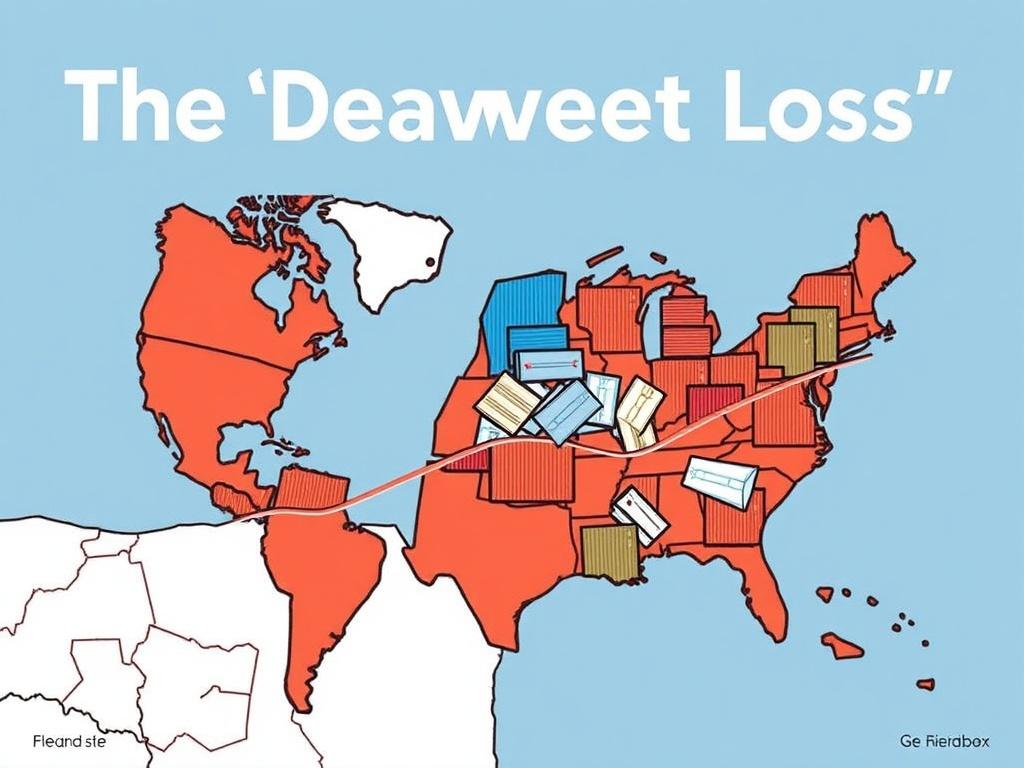
Deadweight loss from a tariff typically comes in two triangular pieces on the standard supply-and-demand graph. One triangle represents the loss from reduced consumption — consumers who no longer buy because of higher prices. The other triangle represents inefficient domestic production — resources diverted to produce goods at higher cost instead of importing them for less.
These triangles reflect lost mutual gains. For each unit that no longer trades, the buyer’s willingness to pay exceeded the seller’s cost before the tariff, so the potential gain vanished with the price rise. For each unit inefficiently produced at home, the domestic cost exceeds the world price so society pays more in resources than the good is valued by buyers.
Because those gains were real but unearned, they are neither captured by producers nor by the government — they simply disappear. That invisible loss is why tariffs can shrink overall economic welfare even when they help particular industries.
Two kinds of inefficiency
The first inefficiency is allocative: resources are not used where they deliver the highest value. When a tariff protects an inefficient domestic producer, labor and capital remain trapped producing goods that could be obtained more cheaply elsewhere. The second inefficiency is consumption distortion: higher prices mean people purchase less of goods they value above cost, lowering total satisfaction.
Both inefficiencies reduce the economy’s total pie. Political debates often focus on the distribution of pie slices, but deadweight loss is about the size of the pie itself. That explains why broad-based tariffs are rarely justified on efficiency grounds.
Why deadweight loss matters beyond triangles
Economists draw triangles on graphs, but the real-world implications are tangible: higher costs for families, reduced competitiveness for firms that use the taxed inputs, and incentives for businesses to lobby for protection rather than innovate. A small tax on a common input can cascade into higher prices across many products.
Tariffs can also slow productivity growth by sheltering firms from competition. Competition forces companies to become more efficient and invest in better techniques. When a tariff shields a firm, it faces less pressure to cut costs or improve products, which can slow technological progress in that industry over time.
Finally, tariffs can distort international relationships. Retaliatory tariffs invite back-and-forth escalation, harming exporters in politically chosen industries and producing uncertainty that discourages investment and long-term planning.
Real-world examples and my experience
As a writer who has followed trade debates over the years, I’ve seen how tariffs move from abstract policy into household budgets and boardroom strategies. For example, when a high-profile tariff is announced on steel or aluminum, headlines focus on protecting mills and jobs. A few months later, consumers notice higher prices for appliances and construction projects report rising costs.
Those price effects are exactly the channels through which deadweight loss occurs. Firms that use steel as an input effectively pay more and may cut production or pass costs to customers. The initial protection for steel jobs can come at the expense of jobs in steel-using industries, spread out and harder to trace.
Historical episodes offer instructive lessons. The Smoot-Hawley tariffs of the 1930s, while embedded in a complex policy environment, are widely cited for their role in deepening trade disruptions. More recently, tariffs introduced for political or strategic reasons have tended to raise consumer prices and trigger retaliatory measures, with mixed signals about net employment effects.
These real-world patterns align with the economics: tariffs reallocate resources and reduce total welfare even when they appear to help select groups in the short run. That doesn’t mean tariffs never have a role, but it does mean the costs are real, measurable, and often spread unevenly.
When tariffs might make sense
There are circumstances where tariffs are proposed for reasons beyond immediate efficiency. Policymakers sometimes cite the infant industry argument: new domestic industries might need temporary protection until they achieve scale and lower costs. In theory, this allows a promising sector to mature and become internationally competitive.
Another rationale is national security: governments may limit imports of strategic goods to ensure domestic capacity in times of crisis. Tariffs can also be used as leverage in trade negotiations, aiming to extract concessions from trading partners or to retaliate against unfair practices such as subsidies or dumping.
Each justification involves trade-offs. Temporary protection can become permanent through political capture; security exemptions can be stretched; negotiation leverage might incur costs that outweigh any bargaining gains. Evaluating these scenarios requires careful cost-benefit analysis rather than blanket assertions.
Infant industry argument and pitfalls
The idea of protecting an infant industry until it reaches maturity is seductive: give a business a breathing space, and it will grow into a global leader. In practice, the challenge is designing credible, time-limited support and ensuring firms use the protection to invest in productivity rather than rent-seeking.
Political economy complicates the story. Once a group receives protection, it gains constituencies and incentives to lobby for its continuation. Without strict sunset clauses and accountability, temporary tariffs risk becoming permanent barriers to competition and innovation.
A wiser approach often complements targeted support with clear performance benchmarks, worker retraining, and incentives for productivity improvements rather than broad, indefinite tariffs.
National security and strategic uses
National security is a more defensible reason for tariffs in narrow cases — for example, ensuring domestic production of critical defense components. That said, security justifications can be misused to shield unrelated domestic industries and can be hard to verify externally.
Policymakers should define security-related tariffs narrowly and transparently, with periodic review. Otherwise, what starts as a protective measure can morph into a general shield against competition, increasing deadweight loss and eroding public trust in trade policy.
Second-order effects and retaliation
Tariffs rarely operate in isolation. Trading partners often respond with retaliatory measures, putting exporters in harmed sectors at risk. Those second-order effects can offset domestic benefits and sometimes make the policy counterproductive.
Retaliation may hit politically influential industries or regions that supported the tariff, shifting the pain in ways politicians find politically sensitive. This dynamic helps explain why tariff debates can become contentious and unpredictable.
Moreover, modern supply chains are deeply integrated: a tariff on intermediate goods can increase costs for downstream manufacturers who compete internationally, shrinking exports and employment in unexpected places. That complexity raises the real economic cost beyond the simple triangles economists draw.
Measuring deadweight loss in practice
Calculating deadweight loss precisely requires information that policymakers often lack: elasticities of supply and demand, the share of imports affected, and how quickly firms and consumers adjust. Elasticities matter because they determine how much quantities change when prices rise.
If demand is very inelastic, quantity demanded falls little and deadweight loss is smaller, but consumers still pay higher prices. If demand is elastic, small price changes lead to large reductions in quantity and correspondingly larger deadweight losses. The shape of the domestic supply curve is equally important.
International data and econometric studies help estimate these parameters, but estimates vary by product and country. That uncertainty argues for caution: if the costs of protection are unclear and potentially large, restraint may be the prudent policy stance.
Tariff vs. quota: how deadweight loss differs
Tariffs are not the only tool for restricting imports; quotas limit quantity directly. Both can protect domestic producers, but they create different economic outcomes. Tariffs generate government revenue, whereas quotas typically create rents captured by whoever holds the import licenses.
| Policy | Price effect | Revenue or rent | Typical deadweight loss |
|---|---|---|---|
| Tariff | Raises price by tariff amount | Government revenue | Two triangular losses |
| Quota | Raises price to market-clearing level | License holder rents (can be large) | Similar or larger if rents misallocated |
Quotas can generate larger political distortions because rents might be allocated to politically connected firms, encouraging lobbying and inefficiency. Tariffs, while still inefficient, at least produce public revenue that can be used or offset with other policies.
Historical role of tariffs in developing countries
Tariffs historically served as an important source of government revenue in many developing countries before broad-based income tax systems were established. In that context, tariffs were pragmatic tools to fund public goods and institutions. Over time, as tax systems matured and economies opened, reliance on tariffs tended to decline.
That history complicates any blanket claim that tariffs are always harmful. For countries with weak tax administrations, a modest tariff might fund essential services. The trade-off still exists, though: raising revenue through tariffs typically comes with the efficiency costs we’ve discussed. Policymakers need to weigh short-term revenue benefits against long-term growth costs.
Designing fiscal systems that reduce reliance on trade taxes while protecting the revenue base is often a better long-run strategy. It reduces distortions and better aligns tax burdens with capacity to pay.
Elasticities and the scale of the deadweight loss
Elasticities of supply and demand are the engines behind the size of deadweight loss. When consumers can easily substitute away from a taxed good, or when domestic producers can quickly expand production, the quantity changes significantly and the deadweight loss grows. Conversely, very inelastic markets show smaller quantity shifts but still transfer wealth to producers and the government.
In practice, goods with many close substitutes—consumer electronics, many apparel items—tend to have higher elasticities, so tariffs there cause big quantity reductions and large deadweight losses. For niche goods with few substitutes, quantity effects are smaller but consumers still face higher prices and lower welfare.
The lesson is practical: tariffs on goods with elastic demand are particularly costly in terms of foregone welfare. Policymakers should account for elasticity patterns across sectors before choosing trade interventions.
Policy alternatives to tariffs
If the goal is to help specific workers or industries, tariffs are a blunt instrument. More targeted policies can achieve social or strategic aims with less efficiency loss. Examples include temporary subsidies tied to performance, retraining programs for displaced workers, or direct cash transfers to affected households.
Investment in infrastructure, research and development, and regulatory reform can also strengthen domestic industries without erecting trade barriers. These measures improve competitiveness rather than shielding inefficiency. They tend to carry less deadweight loss because they boost productive capacity directly instead of raising prices.
Trade adjustment assistance — programs that help workers transition between jobs — is another policy that addresses political concerns behind tariffs but avoids distorting market prices across the board. A mix of targeted support, investment, and credible trade policy can align protection goals with long-run economic health.
Common misconceptions
One common myth is that tariffs always create domestic jobs. While some jobs in protected industries may be preserved or created, other jobs in user industries and exporting sectors can be lost. The net employment effect depends on how resources are reallocated across the economy.
Another misconception is that tariffs are a simple source of government revenue without cost. As we’ve seen, the revenue comes at the price of reduced consumption and inefficient production; the deadweight loss represents value the government never captures and society never enjoys.
Finally, some believe that tariffs are powerful levers that guarantee better trade terms. While they can be bargaining tools, the risk of retaliation and the damage to competitiveness can outweigh short-term gains. Trade negotiations often work best when backed by credible and narrowly targeted measures rather than broad sweeping tariffs.
Political economy: why tariffs persist
Tariffs persist because their benefits are concentrated and visible, while their costs are diffuse and often modest for any single voter. A factory owner saved by protection gains large, immediate benefits; each consumer pays slightly more, and the cumulative pain is spread across many people and products. That asymmetry makes tariffs politically tempting.
Lobbying also plays a role. Industries that receive protection gain an incentive to organize and defend their rents, while those paying slightly higher prices have less incentive to mobilize. Over time this dynamic can lock in protection even when it is economically inefficient.
Understanding this political logic helps explain why economists often recommend policies that compensate losers and invest in competitiveness rather than relying on tariffs that shrink total welfare for the sake of narrow gains.
Steps to evaluate a tariff proposal
Evaluating whether a tariff is sensible requires clear criteria: identify the objective, measure the likely benefits, estimate the costs including deadweight loss, and consider alternative policies. A systematic approach prevents choices based solely on short-term political gain.
- Define the policy goal (revenue, protection, security, negotiation leverage).
- Estimate demand and supply elasticities to gauge quantity responses.
- Project distributional impacts and likely retaliation risks.
- Compare with targeted alternatives like subsidies or retraining programs.
Applying these steps brings discipline to what can otherwise be an emotionally charged debate. It ensures that policymakers weigh the hidden costs of deadweight loss alongside the visible winners and losers.
Non-tariff barriers and their deadweight effects
Tariffs are not the only source of trade-related deadweight loss. Non-tariff barriers—such as quotas, licensing restrictions, stringent standards, or bureaucratic hurdles—can also restrict trade and create inefficiencies. Sometimes these measures are more opaque and harder to quantify than tariffs, but their economic logic is similar.
For example, restrictive import licensing can limit competition and raise prices just like a tariff, while complex certification rules can raise costs for foreign suppliers and reduce the variety of products available to consumers. The deadweight losses from such barriers are often overlooked because they are less visible than a headline tariff number.
A comprehensive trade policy should therefore consider both tariffs and non-tariff measures, seeking transparency and minimizing unnecessary barriers to efficient exchange.
How to talk about deadweight loss without getting lost in jargon
When explaining deadweight loss to non-economists, I favor plain analogies. Picture a handshake between buyer and seller that creates mutual benefit; a tariff is like slipping a speed bump between them so some handshakes never happen. Those missed handshakes are not someone else’s gain — they are lost opportunities.
Using relatable examples helps. If a tariff on imported coffee raises your morning brew by 50 cents, and you stop buying one cup a week as a result, that lost enjoyment is part of the deadweight cost. Multiply that across millions of consumers and you see why small price changes can add up to substantial economic waste.
This framing keeps the idea concrete and avoids hiding behind graphs and triangles. Policymaking is ultimately about people’s choices and welfare, and deadweight loss translates directly into missed value in those choices.
Final thoughts on tariffs and trade-offs
Tariffs are powerful tools that reshape incentives, redistribute gains, and create losses that are sometimes hard to see. Their political appeal is understandable because they produce visible winners, but those winners often come at the expense of a larger group of consumers and downstream businesses. The economic cost — the deadweight loss — consists of real, forgone benefits that nobody receives.
That doesn’t rule out all uses of tariffs. Temporary, narrowly targeted measures for security reasons or to support well-structured industrial policy can be defensible under certain conditions. The critical test is whether the benefits outweigh the clear and invisible costs and whether there are better alternatives to achieve the same ends.
Ultimately, good trade policy acknowledges the trade-offs, measures the likely deadweight loss, and favors targeted, transparent solutions that raise national welfare rather than simply reassigning slices of a shrinking pie. The conversation about tariffs should focus less on slogans and more on these concrete trade-offs so the public can judge policy by its real effects.