When trade tensions flare and tariff lists appear overnight, a legal mechanism usually sits behind the headlines. Section 301 of the Trade Act of 1974 is the statute most often invoked by Washington when it decides to punish— or pressure— a trading partner. That authority has shaped modern trade disputes, from quiet investigations to full-blown tariff episodes that ripple through supply chains and markets.
- What Section 301 actually authorizes
- How a Section 301 probe begins and proceeds
- The role of the U.S. Trade Representative
- Evidence, standards, and what counts as harm
- Historical use: a tool with long memory
- Notable episodes and their lessons
- How Section 301 fits—or clashes—with the WTO
- Unilateral action versus collective rules
- Economic consequences: ripple effects through prices and investment
- Winners and losers in a trade conflict
- Practical table: typical timeline for a Section 301 action
- Diplomacy and escalation: how a domestic law goes global
- Retaliation, negotiation, and the path back to calm
- Domestic politics: why Section 301 keeps getting used
- Industry lobbying and selective protection
- Legal challenges and judicial review
- Policy debates and reform proposals
- Options for reform
- Business guidance: navigating a Section 301 world
- Real-life example: a manufacturer’s scramble
- Sectoral impact: who will feel Section 301 most?
- Technology, IP, and the modern battleground
- Allies, partnerships, and collective responses
- Cases where coalition-building mattered
- Measuring success: what counts as victory?
- Looking ahead: emerging issues that will shape Section 301 use
- Why the statute will remain relevant
- Practical policy ideas for balancing speed and cooperation
- Final reflections on law, leverage, and unintended consequences
What Section 301 actually authorizes
At its core, the law gives the United States the power to investigate foreign acts, policies, or practices that it deems unreasonable or discriminatory and that burden U.S. commerce. The law tasks the office of the U.S. Trade Representative (USTR) with making findings and recommending remedial action when it identifies harmful foreign behavior.
Remedies under Section 301 can take different forms, including negotiations, sanctions, and most visibly, tariffs or other import restrictions. The statute intentionally grants the executive branch broad discretion to choose the remedy it sees fit, which is why the tool is so flexible—and sometimes controversial.
How a Section 301 probe begins and proceeds
Investigations typically begin with a petition from a domestic industry or on the USTR’s own initiative. Once triggered, the USTR opens a formal review, gathers evidence, invites public comment, and consults with the affected foreign government when possible. That administrative phase aims to document whether a foreign practice is injuring U.S. commerce and whether the practice violates international obligations.
Following fact-finding, the USTR issues a determination. If the office concludes that the foreign practice is harmful, it then develops proposed remedies and publishes them for public comment. Often those remedies are phased: outreach and negotiations come first, and tariffs or other measures are a last resort if consultations fail.
Because the process is administrative rather than judicial, it moves under a different standard than a court case. The USTR’s determinations are driven by policy judgments as well as legal analysis, and the office is accountable to Congress and the president more than to a neutral adjudicator.
The role of the U.S. Trade Representative
The USTR is the linchpin of the Section 301 process. As a cabinet-level office, it combines legal analysis, economic evidence, and diplomatic outreach when pursuing a case. The USTR decides whether to open investigations, which facts to weigh, and which remedies to recommend.
That centralization gives the USTR power to shape trade policy quickly, but it also concentrates politically charged decisions in one office. The USTR must juggle industry petitions, interagency input, foreign relations, and congressional expectations while crafting a response intended to change another country’s behavior.
Evidence, standards, and what counts as harm
To justify action, the USTR looks for practices that are unreasonable or discriminatory and that materially burden U.S. commerce. Examples include denial of market access, patent theft or inadequate intellectual property protection, forced technology transfer policies, and discriminatory standards or subsidies that unfairly disadvantage U.S. firms.
Because the statute is broad, the burden of proof is less narrowly defined than in a court. The USTR evaluates economic data, firm testimony, internal company documents, and public policies. The result is often a mixture of law, economics, and policy judgment rather than a strict legal standard that every decision must meet.
Historical use: a tool with long memory
Section 301 is not new. It traces back to the Trade Act of 1974 and has seen repeated use across administrations. Over decades it has been employed against a range of countries and practices—everything from 1980s pressure on Japanese market access to the more recent disputes involving China’s industrial policies.
Each episode leaves institutional traces: playbooks for how to build cases, templates for public notices, and lessons about what remedies are effective. These precedents influence future choices, making Section 301 both predictable in process and unpredictable in outcome.
Notable episodes and their lessons
When Section 301 was used in the 1980s against Japan, Washington sought to open closed markets and force structural changes in key sectors. Those measures brought attention and some market shifts, but they also led to negotiation rather than long-term unilateral escalation. The episode taught policymakers the value of pairing pressure with diplomacy.
The 2018–2019 use of Section 301 against China represents a more aggressive, tariff-heavy application. Targeting alleged intellectual property theft and coerced technology transfer, the USTR imposed wide-ranging tariffs on Chinese imports. The action illustrated that Section 301 could be used at scale and that tariffs, once imposed, are hard to withdraw without reciprocal concessions.
How Section 301 fits—or clashes—with the WTO
The World Trade Organization (WTO) is built on a rules-based system that favors multilateral dispute settlement. Section 301’s unilateral remedies sometimes collide with that system because it permits the U.S. to impose countermeasures without prior WTO authorization.
This tension raises hard questions. The U.S. argues that Section 301 corrects unfair practices faster than multilateral dispute settlement allows, especially when time-sensitive issues like technology transfer are at stake. Critics contend it undermines the global trading order by encouraging self-help remedies that can spark retaliatory cycles.
Unilateral action versus collective rules
WTO dispute settlement can be slow, and ruling or enforcing a remedy requires consensus among members or the passing of long-standing procedural hurdles. Section 301 offers a faster, more flexible route, but speed can come with diplomatic costs and legal pushback in international fora.
In practice, the U.S. sometimes coordinates with allies before acting and other times proceeds on its own, depending on the issue’s urgency and political considerations. That inconsistency has produced both strategic gains and diplomatic friction.
Economic consequences: ripple effects through prices and investment
Tariffs imposed under Section 301 change relative prices overnight, making imports more expensive and domestic substitutes relatively cheaper. Consumers often pay the bill through higher retail prices, while some domestic producers gain temporary competitive breathing room.
Longer term, tariffs create uncertainty that affects investment decisions. Multinational firms weigh the risk of sudden policy shifts when choosing where to locate production or invest in supply chains. Uncertainty can depress cross-border investment and slow innovation at the margins.
Winners and losers in a trade conflict
Exporters to the targeted country can suffer direct losses; firms that compete domestically with imports can see short-term gains. Logistics providers and customs brokers often benefit from increased paperwork and re-routing of supply chains. Consumers and downstream manufacturers typically face higher input costs and reduced choice.
Politically, winners often include organized industries that lobby for relief, while costs are dispersed among millions of consumers who rarely mobilize in the same way. That distribution of costs and benefits helps explain why trade remedies can endure even when they harm economic efficiency.
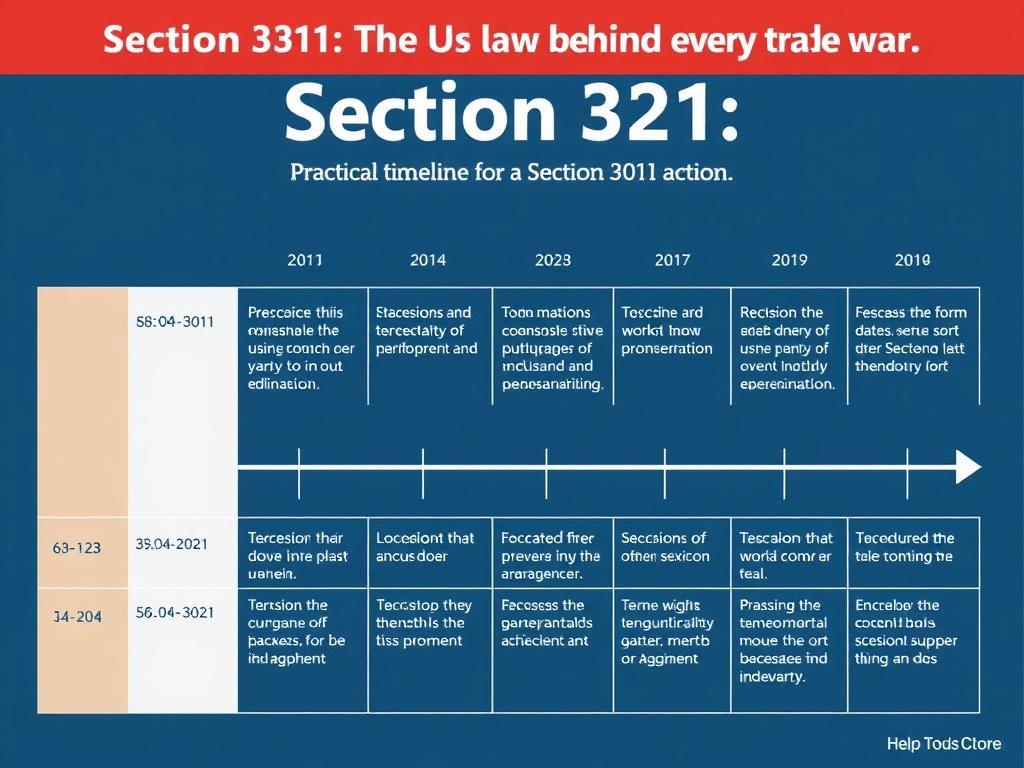
Practical table: typical timeline for a Section 301 action
| Step | Typical duration | Purpose |
|---|---|---|
| Petition or initiation | Days–weeks | Trigger formal review |
| Fact-finding and public comment | Weeks–months | Gather evidence, hear stakeholders |
| Determination and proposed remedies | Weeks | Announce findings and options |
| Consultations with foreign government | Weeks–months | Solve issue diplomatically |
| Implementation of remedies | Immediate–months | Apply tariffs, negotiate exclusions |
Diplomacy and escalation: how a domestic law goes global

When the U.S. uses Section 301, foreign governments rarely treat it as a purely legal act. They respond politically, sometimes with countermeasures or by taking the dispute to multilateral institutions. The result can be bilateral negotiations, tit-for-tat tariffs, or broader diplomatic friction.
Because trade policy intersects with national security, alliances, and investment, a Section 301 decision can cascade into other areas—technology controls, investment screening, export restrictions, and even geopolitical alignments. Policymakers must weigh those downstream impacts when crafting remedies.
Retaliation, negotiation, and the path back to calm
A common pattern is escalation followed by negotiation. Initial tariffs prompt retaliation; the economic pain on both sides creates incentives to bargain. Successful negotiations often combine tariff rollbacks with commitments on the underlying policy issues, though such agreements can be fragile.
Sometimes the dispute settles with side deals that stop short of full structural reform, which can leave unresolved grievances ready to flare up later. That outcome reflects the political reality that sweeping foreign policy changes are difficult to extract through trade remedies alone.
Domestic politics: why Section 301 keeps getting used
Section 301 appeals to elected officials for several reasons. It offers a visible way to show toughness on unfair trade practices, it responds to concentrated domestic lobbying, and it provides tangible action that can be framed as defending jobs and intellectual property.
The statute’s flexibility also makes it attractive: presidents and trade representatives can tailor remedies to political needs without waiting for lengthy congressional action. That administrative agility, however, can deepen partisan debates about trade strategy and its costs.
Industry lobbying and selective protection
Trade remedies often reflect the intensity of lobbying. Industries that are concentrated, well-organized, and politically connected are more likely to secure relief. Agriculture, steel, and certain high-tech sectors have historically used the petitions process to gain attention and protection.
That dynamic explains why some measures seem economically inefficient yet politically durable. Section 301 allows targeted protections that can be sold to domestic constituencies even when economists argue the benefits are limited or fleeting.
Legal challenges and judicial review
Although Section 301 decisions are administrative, they can be subject to judicial review in U.S. courts. Courts typically defer to the USTR’s policy judgments but can scrutinize whether the agency followed required procedures and whether its findings have a reasonable basis.
Litigation tends to focus on whether the agency considered the right factors, adhered to notice-and-comment requirements, and stayed within statutory limits. Successful challenges are possible but rare, given the deference afforded to the executive branch on foreign trade policy.
Policy debates and reform proposals
Scholars and policymakers disagree about how Section 301 should evolve. Some see it as an essential tool to counter unfair foreign industrial policy, especially in fast-moving technological fields where multilateral rules lag. Others argue it should be constrained to preserve the WTO framework and avoid escalation.
Proposals range from greater congressional oversight and clearer statutory standards to enhanced coordination with allies and pre-commitment to using WTO dispute settlement first. Each reform option trades off speed and unilateral leverage for predictability and multilateral legitimacy.
Options for reform
One practical reform is to require the USTR to demonstrate prior attempts at multilateral or bilateral consultation before resorting to tariffs. Another is to narrow the statutory language so remedies are limited to practices that clearly violate international obligations or that cause demonstrable economic harm.
Enhanced transparency—regular reporting to Congress and publication of internal analyses—could also reduce politicized applications. Finally, building allied coalitions before action would increase the pressure on offending countries while lowering the risk of unilateral backlash.
Business guidance: navigating a Section 301 world
For companies, the reality is that Section 301 actions are part of the policy landscape. Firms with global supply chains need playbooks to respond quickly to tariffs and to exploit administrative relief options like exclusion requests and tariff classification reviews.
Preparation reduces disruption. Keeping detailed supplier data, diversifying sourcing, and maintaining robust tariff cost models help firms adapt when measures arrive. Engaging trade counsel early and participating in industry associations also strengthens a company’s voice during rule-making and exclusion processes.
- Map your supply chain thoroughly, including tiers 2 and 3 suppliers.
- Track tariff lines and keep commodity classifications up to date.
- Build a playbook for exclusion petitions and public comments.
- Consider nearshoring or dual sourcing for critical inputs.
- Engage with trade associations to amplify industry concerns.
Real-life example: a manufacturer’s scramble
I once sat in a factory conference room with a small electronics firm the week after a new tariff list hit. The CFO showed spreadsheets with input costs that had jumped overnight, while the operations team mapped alternative suppliers that could requalify within months—if only the firm could absorb the transition cost.
The company filed for exclusions while accelerating talks with a Southeast Asian assembler. They preserved relationships with key customers by offering price cushions and by re-designing product kits to use fewer tariffed components. The episode illustrated a basic truth: agility and preparation matter more than outrage when policies change fast.
Sectoral impact: who will feel Section 301 most?
Sectors with complex international supply chains—electronics, automotive, and machinery—face outsized exposure. Those industries rely on finely tuned cross-border flows and just-in-time production, so tariffs can disrupt inventory strategies and certification timelines.
Conversely, more domestically focused services firms may be insulated from immediate import duties but can feel the secondary effects through higher input costs and weaker export demand when trading partners retaliate.
Technology, IP, and the modern battleground
Technology policy—especially around intellectual property, data governance, and forced technology transfer—has become a central rationale for recent Section 301 actions. Governments that tie market access to technology sharing create friction points that the USTR is primed to address.
Because technologies evolve faster than international norms, Section 301 provides a rapid-response tool to press for enforcement or behavioral change. That speed is useful but also risks overreach when complex technical questions drive policy choices.
Allies, partnerships, and collective responses
When trade disputes have broad implications—say, on semiconductor policy or industrial subsidies—coordination among like-minded countries increases leverage. Joint action spreads the burden and signals unified norms about government intervention in markets.
Yet coalitions are hard to build quickly. Different countries have distinct exposures and political constraints, so aligning on both targets and remedies takes time and diplomacy. In the absence of unanimity, unilateral U.S. moves remain an option, albeit a riskier one.
Cases where coalition-building mattered
In several high-profile subsidy disputes, coordinated pressure from the U.S., EU, and Japan increased the likelihood of concessions because the target faced multilateral economic and reputational costs. Those episodes suggest that collective strategies can be more effective than single-country tariffs.
Still, coalition politics are messy; domestic politics occasionally prevent partners from joining even when they share the underlying concerns. The result is a patchwork of responses that complicates strategic planning for businesses and diplomats alike.
Measuring success: what counts as victory?
Success may look different to different actors. For a trade association, success could be an exclusion for a product line or a temporary suspension of tariffs. For national policymakers, success might be structural reforms in the target country’s policies or enforceable commitments that reduce the risk of future disputes.
Given those varying goals, evaluating Section 301’s effectiveness requires long-run metrics: have foreign policies changed, have market conditions improved for U.S. firms, and are actions sustainable without ongoing tariff pressure? Many cases produce partial gains rather than clean, permanent solutions.
Looking ahead: emerging issues that will shape Section 301 use
The rise of artificial intelligence, semiconductor strategic competition, and data governance will create new pressure points. Governments seeking technological catch-up may adopt aggressive industrial policies, and the U.S. may turn to Section 301-style measures to counter perceived coercion or theft.
Supply chain resilience, reshoring, and export controls will intersect with trade remedies. Policy choices will increasingly blend trade, investment screening, and technology controls into a toolkit that makes the borders between different policy domains fuzzier—and the stakes higher.
Why the statute will remain relevant
Section 301 endures because it is flexible and politically visible. When a domestic industry feels wronged, the statute provides a clear administrative pathway for redress. Until alternative multilateral institutions or agreements can respond faster and more credibly, governments will keep this unilateral lever on the table.
That persistence means businesses need to assume the possibility of sudden policy shifts and keep contingency plans ready. It also means trade officials must continue to balance speed with international legitimacy when deciding to act.
Practical policy ideas for balancing speed and cooperation
One pragmatic approach is to pair Section 301 authority with clear escalation ladders: mandatory consultations, coordinated allied actions, then targeted remedies. Such a ladder retains speed while preserving avenues for diplomatic resolution.
Another idea is to formalize timelines for exclusion processes and create predictable review mechanisms, reducing business uncertainty and easing bureaucratic bottlenecks. Transparency, clear legal standards, and stronger congressional oversight can also make the tool less politically charged.
Final reflections on law, leverage, and unintended consequences
Section 301 sits at the intersection of law, economics, and geopolitics. It offers the U.S. government a powerful mechanism to push back against practices seen as unfair or coercive, but that power is double-edged: it can deter bad behavior or ignite trade wars that raise costs for ordinary consumers and businesses.
As globalization recalibrates and strategic competition intensifies, policymakers will continue to wrestle with when to use unilateral leverage and when to invest in multilateral solutions. For firms and citizens, the practical imperative is the same: prepare for policy shocks, engage in the process, and push for reforms that make trade remedies predictable, targeted, and effective.