Tariffs sit at the intersection of trade, politics, and public finance, yet the path that tariff dollars travel from the dock to government coffers is rarely obvious. This article follows that path: who collects those payments at the border, how they are calculated, what happens to the money afterward, and why the answers vary between countries and policy choices. Read on for practical details, national examples, and the economic logic that turns a customs stamp into policy outcomes.
- The actors at the border: who actually collects tariffs
- How tariff money is calculated and collected at the border
- Typical steps in tariff collection
- Where tariff money goes inside government
- Why the destination matters
- Country examples: how different systems treat tariff revenue
- The United States in detail: customs, tariffs, and the Treasury
- How the European Union handles customs duties
- Special cases: earmarked duties, trade remedies, and dedicated funds
- Historical perspective: tariffs as the old backbone of government finance
- Tariffs as policy tools: revenue versus protection
- Transparency and reporting: how tariff revenues are tracked publicly
- Practical guidance for importers: what to expect and how to manage tariffs
- Checklist for importers
- Enforcement, evasion, and the shadow economy
- Trade wars, tariffs, and temporary reallocations
- How developing countries rely on tariffs differently
- Legal frameworks shaping tariffs and collections
- Fiscal and political consequences of tariff use
- Audit, oversight, and good governance
- Technological changes: how digitization affects collection and transparency
- Real-life example: a small importer’s perspective
- Where tariff revenue does not go: common misconceptions
- International coordination and revenue-sharing arrangements
- Tariffs and the consumer: incidence and real-world effects
- Emerging issues: digital trade, services, and the shrinking tariff base
- Policy trade-offs: simplicity, fairness, and administrative feasibility
- Practical reforms to improve collection and use of tariff revenues
- Final thoughts: following the money clarifies policy
The actors at the border: who actually collects tariffs
At the moment goods cross a border, responsibility for assessing and collecting tariffs rests with customs officials — employees of a government agency charged with managing the flow of goods. These agencies have many names: customs authorities, border services, or revenue services with customs divisions, depending on the country. Their work includes classifying goods, checking values, and ensuring the right duty is paid before release.
Customs agencies operate on the front line of revenue collection and enforcement. They process import declarations, inspect cargoes when necessary, and levy penalties if rules are broken. Importers, customs brokers, and freight forwarders usually interact most with customs staff during this process, preparing paperwork and arranging payments.
Beyond customs agencies, other government entities can be involved: ministries of finance set tariff schedules, trade ministries negotiate rates in treaties, and specialized agencies may impose additional levies (for health, environment, or security). But the physical collection is almost always done by the customs or border authority at the point of entry.
How tariff money is calculated and collected at the border
Before a penny changes hands, customs determines the tariff basis: What is being imported, how it is classified, and what its customs value is. Classification uses the international Harmonized System (HS) codes, a common language that assigns a numeric code to each kind of product. The HS code tells customs which duty rate applies.
Valuation follows rules laid out in the WTO Customs Valuation Agreement for most countries, typically using the transaction value — the price actually paid or payable for the goods. From that taxable base, customs applies ad valorem percentages, specific amounts per unit, or sometimes a combination of both to calculate the duty due.
The paperwork includes commercial invoices, bills of lading, packing lists, and often certificates of origin for preferential treatment under trade agreements. Importers or their brokers submit a customs declaration, pay duties electronically or at a customs office, and receive clearance documentation before goods can move into the domestic market.
When goods are temporarily imported, held in bonded warehouses, or transshipped, customs can defer or suspend duty collection under specific regimes. These procedures require guarantees and careful record-keeping, because the goods remain under customs control until duties are paid or goods exit the territory again.
Typical steps in tariff collection
The following list outlines a typical sequence at most ports of entry and can help importers anticipate costs and timing:
- Goods arrive and are manifested with shipping documents.
- Importer or customs broker files an import declaration with customs, including HS codes and value.
- Customs assesses duties and taxes based on classification and valuation.
- Payment is made and customs issues clearance, or cargo is held for inspection.
- Goods are released for domestic distribution, bonded storage, or re-export depending on the situation.
Where tariff money goes inside government
Once collected, most tariff revenue flows into a country’s central treasury — the general fund that finances government operations. Tariffs are often recorded as customs duties or import duties in budget documents and considered part of tax revenue. From there, the money becomes available for appropriation alongside other revenues like income and sales taxes.
How the funds are used depends on the budget process. Legislatures or executive branches allocate revenues to defense, infrastructure, social programs, debt service, and other priorities. In effect, a tariff dollar paid at the dock transforms into public spending determined by political choices several steps removed from the trade transaction.
In some countries a portion of tariff revenue is earmarked for specific purposes. Governments may direct revenues to customs operating budgets, port authorities, agricultural compensation funds, or special stabilization accounts. These earmarked uses are exceptions rather than the rule and usually reflect domestic policy aims or political compromises.
Why the destination matters
Knowing where tariff revenue lands is more than bookkeeping. If the money feeds the general fund, tariffs act like any other tax revenue — they reduce the need for other taxes or increase spending. If revenue is earmarked to compensate affected industries or fund border infrastructure, tariffs may be used deliberately as instruments of industrial or regional policy. Understanding the destination clarifies whether a tariff is primarily a revenue source, a protectionist tool, or both.
Country examples: how different systems treat tariff revenue
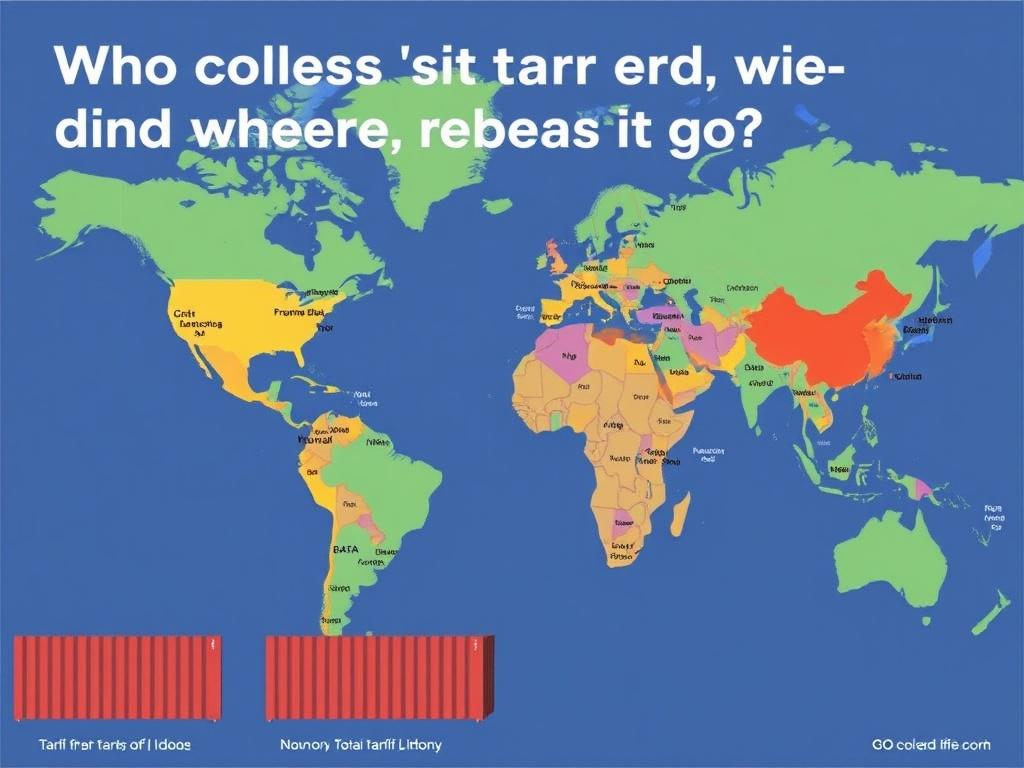
Different countries handle tariff collection and allocation in noticeably different ways, but the pattern is broadly similar: customs agencies collect and central treasuries receive the money. Below is a compact overview showing typical arrangements in several major jurisdictions.
| Country or region | Collecting agency | Where revenue goes | Notes |
|---|---|---|---|
| United States | U.S. Customs and Border Protection (CBP) | U.S. Treasury (general fund) | Duties are deposited as customs revenue; special tariffs have been politically repurposed at times. |
| European Union | Member-state customs authorities | Most transferred to EU budget; member states retain a collection fee | Customs duties on non-EU imports are part of EU “traditional own resources.” |
| United Kingdom | HM Revenue & Customs (HMRC) | HM Treasury (general fund) | Post-Brexit reforms altered tariff schedules and collection mechanisms. |
| China | General Administration of Customs | Central government budget | Tariffs remain a significant revenue item and trade policy tool. |
| Developing countries | National customs agencies | National treasuries; sometimes shared with local governments | Tariff revenue can be a larger share of overall revenue, influencing fiscal dependence. |
That table reflects general practice rather than exhaustive detail, but it highlights the consistent role customs plays and the typical destination: government budgets. Variations arise where supranational budgets, collection fees, or special funds come into play.
The United States in detail: customs, tariffs, and the Treasury
In the United States, CBP — part of the Department of Homeland Security — is the operational collector. CBP officers examine and clear imports, calculate duties, and ensure compliance with trade law. The amounts collected are recorded as customs duties and transferred into the U.S. Treasury on a regular basis.
The Treasury treats those collections as receipt items in the federal budget, available for appropriation by Congress. Over the last century the share of federal revenue from tariffs has fallen dramatically, but they remain an important source of receipts and a powerful policy lever in international disputes or national security cases.
Special tariff measures — for instance under Section 232 (national security) or Section 301 (unfair trade practices) — can draw attention and political debate about how revenues should be used. Regardless of the policy rationale, the cash itself typically lands in the same federal pot unless Congress or legislation specifies otherwise.
How the European Union handles customs duties
The EU is an interesting case because it blends national collection with supranational budgeting. Member-state customs authorities collect duties on imports from outside the EU, and the proceeds are largely transferred to the EU budget. Member states retain a portion to cover collection costs and administration.
This arrangement supports the EU’s single market goals and finances common policies. It also means that customs rules and tariffs on non-EU goods are negotiated collectively, while collection remains a national responsibility carried out under common procedures and IT systems.
Special cases: earmarked duties, trade remedies, and dedicated funds
Governments sometimes earmark tariff revenue for targeted purposes. For example, a country might direct a portion of duties to border infrastructure upgrades, customs modernization, or programs that offset the impact of trade shocks on local industries. These earmarks are political choices that signal priorities rather than technical necessities.
Trade remedy duties — anti-dumping, countervailing, or safeguard measures — are particularly political. The duties are collected by customs like any other tariff, and most often enter the general budget. However, some governments or programs channel portions into compensation schemes for affected sectors, depending on the legal framework and political arrangements at the time.
Because earmarks and special funds are exceptions, they often attract scrutiny. Legislators or watchdogs ask whether earmarking skews incentives, creates rigidities in budgeting, or produces perverse outcomes where tariff policy aims to finance specific interest groups rather than serve the public interest.
Historical perspective: tariffs as the old backbone of government finance
For much of the 18th and 19th centuries, tariffs were the dominant source of central government revenue in many countries. Before income taxes, customs duties funded wars, built infrastructure, and supported nascent public administration. The shift toward internal taxation is a relatively recent development in fiscal history.
Political battles over tariffs shaped nations. Debates about protection versus free trade, regional economic interests, and state formation often centered on who bore tariff burdens and who benefited from tariff protection. The U.S. Civil War era and the industrialization of Europe each show how tariff policy and public finance were tightly interwoven.
As global trade liberalized through the 20th and 21st centuries, tariffs declined as a share of government revenue, especially in advanced economies. Nonetheless, they remain a visible and sometimes flexible lever for policy when politics or strategic interests call for it.
Tariffs as policy tools: revenue versus protection
It helps to separate two functions of tariffs: raising revenue and protecting domestic producers. When designed mainly for revenue, tariffs are applied to raise funds efficiently with minimal market distortion. When protection is the goal, tariffs can be set higher for certain sectors, raising domestic prices and sheltering local firms.
In practice, many tariffs do both. A tariff that protects a nascent industry also generates government revenue. Policymakers must decide which purpose takes precedence and weigh trade-offs: protection can provoke retaliation and reduce economic efficiency, while revenue-focused tariffs can be regressive, disproportionately affecting consumers with lower incomes.
Economists study tariff incidence — who actually bears the cost of a tariff. Consumers often pay higher prices, producers may receive some benefit, and importers can face reduced margins. The ultimate incidence depends on market structure, elasticity of supply and demand, and how easily trade partners can redirect supplies.
Transparency and reporting: how tariff revenues are tracked publicly
Public transparency varies by jurisdiction, but many countries report customs revenue in public budget documents and statistical releases. National treasuries publish receipts and customs agencies often publish operational statistics on enforcement, collections, and clearance times.
International organizations also compile data. The World Bank, IMF, and WTO provide comparative statistics that help observers see how important tariff revenue is relative to GDP or total government receipts. These data are useful for researchers and policymakers monitoring fiscal dependence on trade taxes.
For civil society and businesses, transparency matters because it affects trust in the system. Clear reporting reduces suspicions of misallocation, corruption, or opaque earmarking. Strong auditing and budget oversight help ensure that collections serve public rather than private interests.
Practical guidance for importers: what to expect and how to manage tariffs
If you import goods, the practical question is not only who collects tariff money and where it goes, but how to make the process predictable and cost-effective. Hire a competent customs broker, maintain clean invoices, and classify goods accurately under HS codes. Small mistakes can trigger delays, inspections, and unexpected duties.
Plan for duties in pricing and cash flow. Tariff payments are often due at or soon after clearance, so importers must have liquidity or use bonded warehouses to delay payment. Tariff costs should be integrated into landed cost calculations so that pricing decisions and margin planning are realistic.
Take advantage of trade agreements, tariff preferences, and duty drawback regimes where legally applicable. Certificates of origin can substantially reduce or eliminate duties under free trade agreements, and drawback programs may allow refunds of duties when goods are re-exported or used in manufacturing for export.
Checklist for importers
- Verify correct HS classification and customs value.
- Secure accurate certificates of origin for preferential treatment.
- Work with licensed customs brokers and attorneys for complex cases.
- Use bonded storage or temporary admission when appropriate to defer duties.
- Track tariff changes and trade remedies that may affect your product.
Enforcement, evasion, and the shadow economy
Not all tariff revenue due is collected. Smuggling, under-invoicing, misclassification, and corrupt facilitation can reduce collections and distort competition. Customs enforcement combats these risks with inspections, audits, intelligence sharing, and trade data analysis.
Digitization has strengthened customs’ ability to detect anomalies: electronic manifest data, risk-scoring algorithms, and cross-border data exchange make it harder to hide trade flows. Still, enforcement capacity varies widely. Developing countries may rely more heavily on trade taxes and therefore face stronger incentives for evasion and corruption.
Combating evasion improves revenue and levels the playing field for compliant businesses. Investments in training, technology, and institutional independence for customs authorities pay dividends in both fiscal terms and trade facilitation.
Trade wars, tariffs, and temporary reallocations
When governments impose large new tariffs as part of a trade dispute, revenue flows spike in the short run — but so do economic distortions. Importers may shift sourcing, consumers face higher prices, and downstream industries can suffer from more expensive inputs. Lawmakers sometimes propose using tariff revenues to compensate harmed sectors, but such reallocations require explicit legislative action.
In practice, ad hoc measures occasionally redirect funds. For example, after sudden tariff hikes, legislatures or executive agencies may create relief programs or subsidies financed by the new receipts. Those arrangements are political and temporary rather than structural changes in how tariff money is handled by the treasury.
Longer-term trade wars, however, can change import flows and lower tariff revenues as trade volumes decline or shift to other suppliers and routes. That dynamic illustrates why tariffs are an unstable long-term revenue source if set primarily for protection or retaliation rather than structured fiscal policy.
How developing countries rely on tariffs differently
In many low- and middle-income countries, tariffs still constitute a sizable share of government revenue compared with high-income economies. This legacy stems from less developed tax administrations, lower capability to collect broad-based income taxes, and historical reliance on trade taxes as an accessible revenue source.
Dependence on tariffs shapes policy: governments may be reluctant to liberalize trade without compensating revenue reforms, and they may use tariffs selectively to protect local producers while raising funds. International assistance and domestic tax reform can help shift the revenue base toward more efficient and equitable sources.
Customs modernization — improving IT systems, risk management, and border cooperation — can increase collections while facilitating trade. The goal for policymakers is to reduce leakage, broaden the tax base, and ensure that tariff policy is not the mainstay of fiscal sustainability.
Legal frameworks shaping tariffs and collections

Tariff laws and customs codes set the legal scaffolding for collection, classification, valuation, and penalties. International agreements, such as WTO commitments and free trade agreements, constrain rates and require transparent administration to ensure non-discrimination. Domestic customs law fills in procedural and enforcement details.
Customs valuation, preferential origin rules, and anti-dumping procedures are all legal constructs that affect how much and when money moves from importers to governments. Clear statutory language and sound administrative rules reduce disputes and litigation, making the collection process more predictable for business and revenue more reliable for governments.
Dispute mechanisms at the national and international levels also matter. Importers may appeal assessments, and trade partners may challenge measures at the WTO. The legal environment shapes not only collection mechanics but also the political costs of different tariff choices.
Fiscal and political consequences of tariff use
Tariffs are never just technical taxes; they are political instruments. Politicians may use them to signal toughness on trade partners, to reward or protect constituencies, or to raise visible revenue. That political character can lead to short-term benefits but also to misalignments between economic efficiency and electoral incentives.
Because tariff revenue is visible at ports and easy to track, it can be tempting to allocate it to high-profile projects that curry political favor. That temptation needs balancing with sound fiscal management and transparency to ensure long-term public benefit rather than opportunistic spending.
The distributional impact also carries political weight. Tariffs tend to raise consumer prices, which can provoke public backlash, while benefits accrue to protected producers and possibly government payrolls. Legislators must navigate these trade-offs carefully if tariff policy becomes a campaign issue.
Audit, oversight, and good governance
Strong oversight mechanisms — internal audits, national audit offices, parliamentary committees, and independent watchdogs — ensure that tariff monies are correctly recorded and appropriately spent. Without such checks, collection can be undermined by fraud, diversion, or opaque earmarking.
Customs administrations that publish performance indicators and cooperate with civil society and international partners build credibility. Auditable processes and clear accounting help ensure tariffs fund public goods rather than inscrutable or corrupt slush funds.
International technical assistance often focuses on customs modernizations that improve both collections and governance, supporting the dual goals of fiscal sustainability and trade facilitation.
Technological changes: how digitization affects collection and transparency
Digitization has changed the customs landscape dramatically. Electronic declarations, pre-arrival processing, and single-window systems speed clearances and decrease in-person contact and opportunities for bribery. These systems also generate data that can be mined for revenue assurance and risk management.
Automated risk-scoring and analytics help customs target inspections where they are most likely to find violations, maximizing enforcement effectiveness while reducing delays for compliant traders. Better data also allows treasuries to forecast revenue and detect trends that require policy responses.
However, technology requires investment and skilled staff. Poorly implemented systems can create bottlenecks, and cybersecurity becomes an issue when sensitive trade and payment data is centralized electronically.
Real-life example: a small importer’s perspective
Some years ago I assisted a small company that imported artisanal ceramics. They underestimated duties in pricing, which led to a sudden cash squeeze when several containers were held pending valuation queries. Working with a customs broker we corrected classifications and arranged temporary bonding to release goods, allowing the business to meet customer commitments while resolving the duty assessment.
The episode illustrated how tariff money is not just abstract public revenue but a cashflow reality for businesses. It also underscored the roles of customs brokers, accurate documentation, and contingency arrangements in navigating the process without excessive cost or delay.
For the company, the tariffs ultimately became part of their cost structure, but smoother compliance practices reduced future surprises and strengthened supplier relationships — a small-scale example of how correct handling of tariff flows benefits both private and public interests.
Where tariff revenue does not go: common misconceptions
A frequent misconception is that tariffs paid by importers automatically go to compensate domestic industries displaced by imports. In most countries, tariffs simply enter the general budget unless specific legislation designates otherwise. Any compensatory payments require explicit programs funded by lawmakers.
Another myth is that tariffs are a steady, dependable funding stream immune to economic cycles. In reality, tariffs fluctuate with trade volumes, price movements, and policy changes. Reliance on tariffs without a broader fiscal base can expose governments to volatility.
Clearing up these misconceptions helps citizens and businesses understand the real policy choices behind tariff imposition and the practical steps needed for compliance and strategic planning.
International coordination and revenue-sharing arrangements
In federations or supranational arrangements, revenue-sharing complicates where tariff money ultimately lands. Revenue may be split between central and regional governments, or transferred to a supranational budget as in the EU’s case. These arrangements are political bargains reflecting governance structures and fiscal needs.
Cooperation between customs agencies across borders also affects revenue. Mutual administrative assistance, information sharing, and coordinated enforcement reduce opportunities for evasion and ensure that duties are collected where legally due. Such cooperation is increasingly common through bilateral agreements and international organizations.
For border regions and trading blocs, harmonized practices not only facilitate trade but also clarify how revenue is allocated and accounted for across jurisdictions.
Tariffs and the consumer: incidence and real-world effects
From a consumer’s viewpoint, tariff money typically shows up as higher retail prices for imported goods or for domestically produced goods that use imported inputs. This incidence can be immediate for final goods or gradual and diffuse across supply chains for intermediate inputs.
Regressive effects matter: households with lower incomes spend a larger share of their budgets on traded goods and therefore may feel tariff increases more acutely. Policymakers who care about equity need to weigh these distributional effects when designing trade policy and complementary social measures.
Understanding who ultimately pays helps frame debates about tariffs as part of broader fiscal and social policy, not simply as trade instruments or revenue sources divorced from everyday costs.
Emerging issues: digital trade, services, and the shrinking tariff base
Global trade increasingly involves services and digital goods, which are not taxed by traditional import tariffs. As manufacturing’s share of trade shifts and data flows intensify, tariff revenue potential declines relative to the scale of cross-border economic activity. Governments are adapting by broadening tax bases to include digital transactions, VAT on imports, and other instruments.
This shift raises strategic questions: should governments rely less on tariffs and more on domestic taxes? How do we ensure equity and enforcement in the digital era? Answers vary, but the trend is clear — traditional tariff collections will play a smaller role in the overall revenue mix for many economies.
At the same time, customs administrations must modernize to address non-traditional challenges like cybersecurity, e-commerce package processing, and cross-border data sharing to ensure compliance and revenue protection.
Policy trade-offs: simplicity, fairness, and administrative feasibility
Designing tariff policy means balancing simplicity, progressivity, and administration costs. A broad-based, low-rate tariff system is easier to administer and less distortionary but may be politically unpalatable where concentrated industries seek protection. Conversely, targeted tariffs protect specific firms but invite evasion, complexity, and lobbying.
Administrative capacity matters. In countries with limited capacity, keeping the tariff structure simple can maximize collections and reduce arbitrage. Where capacity is high, more nuanced policy instruments and enforcement can support complex trade remedies and preferential treatments.
Ultimately, the question of who collects tariff money and where does it go? ties into these design choices: collection is administrative, but allocation is political, and both shape economic outcomes.
Practical reforms to improve collection and use of tariff revenues
Reforms that modernize customs procedures, digitize borders, and strengthen legal frameworks improve both revenue and trade facilitation. Simplifying tariff schedules, reducing discretionary rates, and adopting transparent valuation rules reduce opportunities for corruption and disputes.
On the spending side, adopting clear budgeting rules and resisting opaque earmarks increases accountability. If tariffs are used to fund specific programs, lawmakers should make those allocations explicit in budget legislation rather than letting informal practices persist.
International assistance and peer learning can accelerate reforms. Multilateral institutions and development partners often help countries implement best practices that raise revenue while supporting trade and development goals.
Final thoughts: following the money clarifies policy
Tariff money begins as a technical calculation at a port of entry, collected by customs authorities and deposited into the public purse. But tracing its route reveals much about a country’s priorities, administrative capacity, and political trade-offs. Whether the money is absorbed into a general treasury, earmarked for a specific fund, or used as a bargaining chip in policymaking matters for firms, consumers, and the public interest.
For importers, the practical lesson is to treat tariffs as part of normal business expense and to invest in compliance and planning. For citizens and policymakers, the lesson is that transparency and strong institutions make tariff policy more effective and fair. The collection is a procedural function; the allocation is a policy choice.
Understanding both sides of that coin makes trade policy less mysterious and opens a clearer conversation about how countries raise revenue, protect industries, and navigate the global economy. Tariffs will remain a visible lever — sometimes clumsy, sometimes useful — but their ultimate value depends on how the collected money is governed and spent.