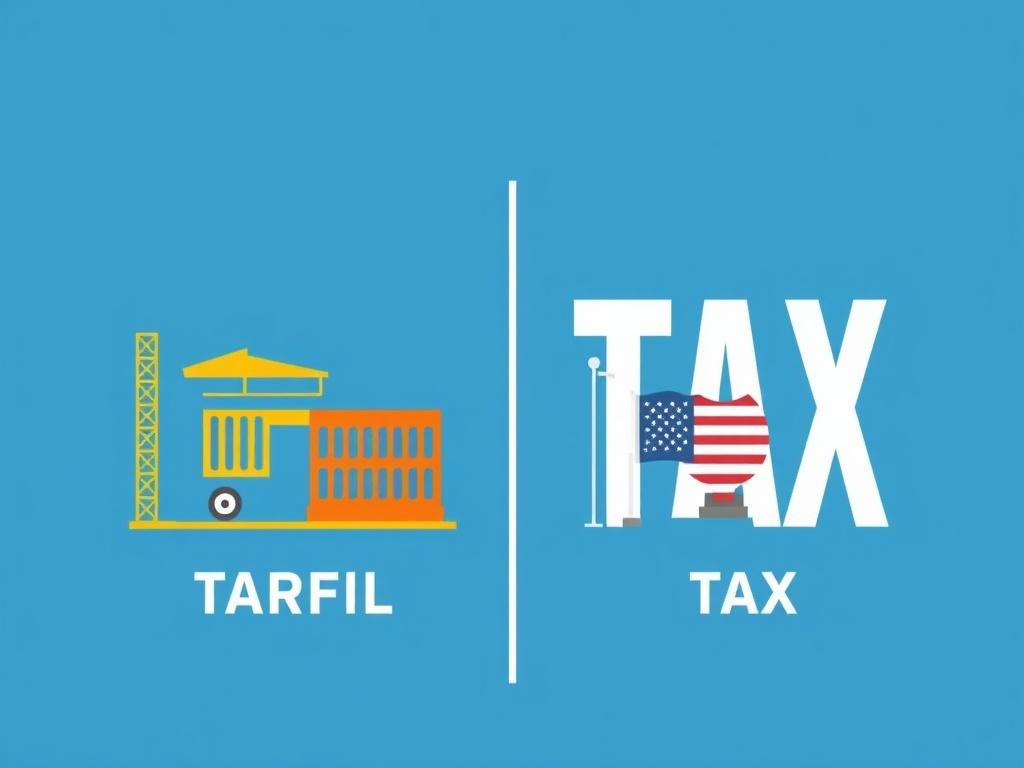
When you hear politicians arguing about tariffs or accountants muttering about taxes, it’s easy to assume they’re interchangeable words for money governments take. They’re not. The difference is clear once you look at purpose, legal authority, mechanics, and economic impact.
- what a tariff is: a targeted border instrument
- purposes of tariffs
- types and examples of tariffs
- what a tax is: a broad domestic levying power
- purposes of taxes
- legal and institutional differences
- who technically pays, and who really bears the cost
- elasticity and pass-through
- economic effects: protection versus efficiency
- terms of trade and strategic tariffs
- tariffs as policy tools: retaliation and bargaining chips
- taxes that affect trade: VAT, excise, and border adjustments
- customs valuation and classification versus tax accounting
- evasion, avoidance, and enforcement
- administrative burden
- historical lessons: when tariffs go wrong
- case study: U.S. tariffs 2018–2020
- case study: VAT and border adjustments in practice
- practical guidance for businesses
- measuring the equivalence: tariff equivalents and tax incidence
- tariff escalation and development policy
- are tariffs hidden taxes?
- alternatives to tariffs for protecting domestic industries
- targeted tax incentives
- how international agreements shape the options
- communication and political economy
- how to talk about these tools in policy debates
- practical checklist for policymakers
- summary comparison table
- closing reflections on policy design
what a tariff is: a targeted border instrument
A tariff is a charge levied on goods as they cross a national border. It is usually applied to imported goods, though historically some countries have taxed exports; the modern use is predominantly import duties intended to affect trade flows or raise revenue at the customs gate.
Tariffs come in a few familiar forms: ad valorem tariffs are a percentage of the value of the good, specific tariffs are a fixed amount per physical unit, and compound tariffs combine both. Each form has different administrative and economic consequences—ad valorem is value-sensitive, while specific tariffs are simple and predictable.
Tariffs are administered at ports of entry by customs authorities, who inspect shipments, classify goods under a harmonized schedule, and calculate the duty owed. The moment of collection is discrete: when the shipment is imported or released into the domestic market, the tariff is due and payable.
purposes of tariffs
Governments set tariffs for several reasons, and they rarely operate for a single purpose. Primary motives include generating revenue, protecting nascent domestic industries, retaliating in trade disputes, and shaping market access as a foreign policy tool.
When protection is the goal, tariffs raise the domestic price of imported goods, giving local producers breathing room to expand or modernize. When revenue is the priority—especially in developing countries lacking robust tax systems—tariffs can be a straightforward way to fund the state.
types and examples of tariffs
Common tariff types include Most-Favored-Nation (MFN) rates set under WTO commitments, preferential tariffs for free trade agreement partners, and temporary safeguard tariffs during sudden import surges. Countries also maintain tariff-rate quotas that combine a low or zero duty up to a threshold, and a higher duty beyond it.
Practically speaking, think of import duties on cars, motorcycles, or textile products. A car imported into Country A might face a 10% ad valorem duty, while certain agricultural imports could face specific fees per kilogram or per ton.
what a tax is: a broad domestic levying power
Taxes are compulsory payments imposed by governments on individuals, businesses, transactions, or property to finance public services and redistribute income. They are the fundamental mechanism by which states collect revenue to run schools, build roads, and support defense.
Unlike tariffs, taxes operate across the domestic economy and take many shapes: income taxes, corporate taxes, sales taxes, value-added taxes (VAT), excise taxes, property taxes, and payroll taxes. Each type has its own base, rate structure, and administrative rules.
Tax collection is ongoing and embedded in economic life—paychecks are withheld, sales taxes are added at checkout, and VAT is computed across production stages. The tax system is typically enforced by a national revenue agency rather than customs officers at the border.
purposes of taxes
Taxes fund public goods and services, influence behavior (like taxing cigarettes to discourage smoking), and redistribute income through progressive rate structures or targeted credits. Policymakers use taxes both to raise predictable revenue and to pursue social objectives.
Where tariffs are often situational or sector-specific, taxes are structural: they shape incentives across the board and provide the fiscal backbone of government operations. Well-designed tax systems balance efficiency, equity, and administrability.
legal and institutional differences
Tariffs and taxes operate under different legal frameworks and institutions. Tariffs are integral to trade law and customs codes, and their setting often involves trade ministries, customs agencies, and international treaty obligations. Taxes, by contrast, are governed by domestic tax law and administered by revenue authorities with a focus on compliance across citizens and businesses.
International bodies like the World Trade Organization place limits and rules on tariffs—binding tariff rates, prohibitions on discriminatory practices, and dispute settlement mechanisms. Taxes are largely domestic matters, though bilateral tax treaties and international standards (like on transfer pricing or base erosion) create cross-border constraints.
This institutional separation means that changes to tariffs often involve negotiations with trading partners and can trigger legal disputes, while tax changes are typically debated within domestic legislatures and shaped by fiscal needs and political priorities.
who technically pays, and who really bears the cost
There’s a short answer and a nuanced answer to who pays a tariff or a tax. Technically, importers remit tariffs to customs. Technically, employers remit payroll taxes and businesses remit VAT and income taxes.
Economically, the burden—known as incidence—depends on supply and demand elasticities. If domestic consumers are insensitive to price increases, an importer can pass most of a tariff on to buyers. If domestic suppliers can’t easily change their output, producers may absorb some of the cost.
In the case of taxes, the same logic applies: statutory incidence (who writes the check) differs from economic incidence (who suffers the real burden). Higher corporate taxes might reduce wages in the long run or lower returns to capital, depending on market conditions and mobility of factors of production.
elasticity and pass-through
Price elasticity matters. When demand is inelastic relative to supply, consumers bear a larger share of the burden; when supply is inelastic, producers bear more. Import tariffs that raise prices of unique goods with little competition tend to be passed on almost fully to consumers.
Empirical studies of pass-through often find incomplete but substantial transfer of tariffs into retail prices. For example, tariffs on steel can ripple through manufacturing costs, raising prices for cars, appliances, and construction materials in measurable ways.
economic effects: protection versus efficiency
Tariffs are blunt instruments that can protect domestic jobs in specific industries but at a cost to overall efficiency. By inflating prices, tariffs create deadweight losses—transactions that would have happened at world prices are foregone at higher domestic prices.
Taxes, when well-structured, can be designed with efficiency and equity in mind. A broad-based consumption tax like VAT can raise revenue with relatively low distortion if rates are uniform and compliance is high. Targeted taxes, such as high excises on tobacco, intentionally distort behavior for social benefit.
Both tools can distort markets, but tariffs’ distortionary effect is concentrated on international trade and specific industries, whereas taxes permeate the economy more evenly. This difference shapes the policy debate about fairness and effectiveness.
terms of trade and strategic tariffs
In theory, a large country can improve its terms of trade by imposing an optimal tariff that lowers the world price of imports, capturing part of the gains through cheaper import prices relative to exports. In practice, this risks retaliation and can trigger damaging trade wars.
Small countries lack market power and therefore cannot influence world prices significantly; tariffs for them are primarily revenue or protection tools. The strategic use of tariffs is more plausible for major economies, but the long-run outcome often depends on political responses and global supply chains.
tariffs as policy tools: retaliation and bargaining chips
Tariffs are frequently used as instruments of trade policy, not merely as revenue measures. Governments levy tariffs to retaliate against perceived unfair trade practices like dumping, or to coerce negotiations over market access and intellectual property protections.
Tariff imposition is public and visible, which makes it a tempting lever in political bargaining. The announcement of a tariff can send a strong signal, mobilize domestic interest groups, and shift bargaining dynamics more rapidly than behind-the-scenes tax changes.
But visibility also invites international backlash. Trade partners can impose counter-tariffs, leading to tit-for-tat escalation that harms exporters and importers on both sides and injects uncertainty into investment decisions.
taxes that affect trade: VAT, excise, and border adjustments
Not all taxes are purely domestic. Consumption taxes like VAT are typically destination-based: they tax goods where they are consumed rather than where they are produced. That raises questions about competitiveness and the need for border adjustments.
Many countries exempt exports from VAT and tax imports at the border to preserve neutrality between domestic and foreign suppliers. This creates a functional similarity to tariffs in the sense that imports face a charge at the border, but the motive and legal basis differ: VAT is a consumption tax, not a trade barrier.
Border-adjustable taxes can be complex to administer and to reconcile with international trade rules. They serve fiscal neutrality but are not intended primarily as protectionist measures, unlike tariffs that explicitly aim to influence trade volumes.
customs valuation and classification versus tax accounting
Administering tariffs requires precise customs valuation and classification under the Harmonized System. Small differences in product description, country of origin, or declared value can radically change the duty owed. This gives rise to customs brokerage, classification disputes, and valuation audits.
Tax administration focuses on income recognition, deductible expenses, and timing of revenue and costs across periods. Transfer pricing and tax avoidance strategies create complex compliance landscapes for multinational firms that differ from customs concerns, though the two can intersect at the point of cross-border transactions.
evasion, avoidance, and enforcement
Both tariffs and taxes are vulnerable to evasion and avoidance, but they take different shapes. Tariff avoidance might involve misclassification of goods, undervaluing shipments, transshipment through third countries, or misdeclaring origin to claim preferential rates.
Tax avoidance includes shifting profits to low-tax jurisdictions, over- or under-stating deductions, and exploiting mismatches in international rules. Tax authorities and customs agencies deploy different tools—audits, cross-border information exchange, and technological surveillance—to block these practices.
administrative burden
For businesses, tariffs often create immediate compliance costs: customs brokers, documentation, and delays at ports. These costs can be disproportionately high for small importers who lack economies of scale in compliance functions.
Tax compliance is continuous and pervasive, requiring payroll systems, bookkeeping, and periodic filings. The administrative burden is routine but can be substantial, especially for firms operating in multiple tax jurisdictions.
historical lessons: when tariffs go wrong
History offers stark warnings. The Smoot-Hawley Tariff Act of 1930 raised U.S. tariff rates on thousands of goods and contributed to global retaliatory tariffs during the Great Depression. Many economists believe it worsened international trade collapse and prolonged economic hardship.
More recent episodes show similar dynamics in miniature. The steel and aluminum tariffs imposed by several governments in recent years protected some domestic jobs while raising costs in steel-using industries and inviting retaliatory duties that hurt exporters in unrelated sectors.
These historical cases underline a recurrent pattern: tariffs can shield small groups at the expense of broader economic efficiency and international cooperation. The net effect often depends on how other countries respond and how integrated supply chains are.
case study: U.S. tariffs 2018–2020
The U.S. administration’s tariffs on steel, aluminum, and a wide range of Chinese imports provide a modern laboratory for studying tariff effects. Some domestic producers benefited from higher prices, while many manufacturers faced increased input costs and supply uncertainties.
Researchers found that while certain steel sectors saw employment gains, downstream industries such as fabricated metal products and machinery experienced job losses and profit declines. Exporters also faced retaliatory tariffs in key foreign markets, weighing on agricultural and manufacturing sectors.
These outcomes illustrate the distributional consequences of tariffs: concentrated benefits to protected industries, dispersed costs to consumers and competitive firms. The political appeal of concentrated gains explains why tariffs recur despite broad economic warnings.
case study: VAT and border adjustments in practice
European Union member states implement VAT with border adjustments that exempt exports and tax imports, preserving neutrality between domestic and foreign suppliers. This system supports an integrated internal market and avoids taxing goods multiple times across production stages.
Businesses exporting from the EU receive VAT refunds or do not charge VAT, which can be administratively heavy but keeps export industries competitive. The approach contrasts with tariff regimes, which can directly raise costs for exporters in partner countries and provoke disputes.
practical guidance for businesses

For importers, understanding tariff classification and origin rules is essential to avoid surprise duties and penalties. Routine practices—accurate invoicing, proper country-of-origin documentation, and proactive tariff engineering—can substantially lower costs and risks.
At the same time, savvy tax planning is necessary to manage effective tax rates without crossing into illegal evasion. Leveraging credits, exemptions, and treaty benefits requires careful documentation and, often, professional advice.
In my experience advising mid-sized manufacturers, a small error in an origin declaration can trigger large retroactive duties and interest charges. Investing in compliance staff and reliable advisors tends to pay off more reliably than risky attempts to stretch rules.
measuring the equivalence: tariff equivalents and tax incidence
Economists sometimes compute tariff equivalents of non-tariff measures or indirect taxes to compare policy instruments. A tariff equivalent tells you how much a tariff would have to be to generate the same price effect as a given regulation or tax.
This analytical approach helps policymakers ask: is a subsidy, regulatory barrier, or tax effectively acting as a protectionist instrument? It also clarifies trade-offs by translating varied instruments into a common metric.
tariff escalation and development policy

Tariff escalation refers to the pattern where raw materials face low tariffs but processed goods face higher tariffs in many countries. This discourages industrialization in developing economies by making it harder to add value locally.
Development-minded policymakers and international negotiators have long debated reducing escalation to promote processing and manufacturing in lower-income countries. The debate blends trade policy with industrial policy and raises questions about the right mix of tariffs, taxes, and support measures for development.
are tariffs hidden taxes?
People sometimes describe tariffs as hidden taxes because they raise the prices consumers pay. In a narrow sense, tariffs are a type of tax on imports, so the phrase has intuitive appeal. But the distinction matters politically and legally.
Tariffs are explicitly tied to cross-border trade and subject to trade law constraints; they are not a general levy on domestic economic activity. Calling them hidden taxes can obscure important differences in intent, administration, and international obligations.
alternatives to tariffs for protecting domestic industries
Policymakers who want to support domestic industries have other tools besides tariffs. Direct subsidies, tax credits for investment, training programs, or procurement preferences can support competitiveness without raising consumer prices at the border.
However, subsidies can be costly and may themselves invite international countermeasures under agreements like the WTO’s subsidy rules. The choice between tariffs and subsidies involves weighing visibility, budgetary cost, and international legal exposure.
targeted tax incentives
Targeted tax incentives—accelerated depreciation, R&D credits, or manufacturing tax credits—can encourage investment while keeping markets open to imports. These incentives are domestic fiscal measures that do not directly interfere with foreign suppliers at the border.
Design matters: incentives must avoid becoming permanent rent transfers to well-connected firms and should be paired with sunset clauses and performance metrics to ensure they promote genuine competitiveness improvements.
how international agreements shape the options
WTO rules, regional trade agreements, and bilateral treaties constrain the use of tariffs and shape tax interactions with trade. Tariff bindings limit maximum rates; rules on non-discrimination and national treatment restrict how tariffs can be applied.
On the tax side, agreements prevent double taxation through treaties, and international standards curb harmful tax practices. Cross-border cooperation on tax matters—such as information exchange and coordinated rules—reduces opportunities for profit shifting and ensures a level playing field.
communication and political economy

Public understanding of tariffs and taxes is often muddled because both raise prices and touch everyday life. Political narratives simplify: tariffs protect jobs, taxes fund public services. Behind those slogans are complex trade-offs and distributional effects.
Interest groups shape policy heavily. A concentrated industry can lobby effectively for tariffs that benefit a small group, while the diffuse group of consumers who pay slightly more for many goods may not mobilize. This asymmetry explains the persistence of protectionist measures despite broad economic costs.
how to talk about these tools in policy debates
When discussing trade policy, be precise about objectives and expected consequences. If the aim is revenue, a well-designed tax may be preferable. If the aim is temporary protection to restructure an industry, clearly defined safeguards and timelines can limit long-term costs.
Policymakers should use evidence: look at elasticities, value chains, and the likelihood of retaliation. Clear, transparent analysis helps separate symbolic politics from durable policy choices that actually improve competitiveness.
practical checklist for policymakers
- Define the objective clearly: revenue, protection, or behavior change.
- Assess distributional impacts: who gains and who loses?
- Consider administrative capacity: customs vs tax authority strengths.
- Evaluate international legal constraints and likely retaliation risks.
- Prefer temporary, targeted measures with exit strategies when protecting industries.
This checklist can help avoid knee-jerk choices and ensure that actions align with broader economic and diplomatic goals. It also frames the question: would a tax reform or a tariff adjustment better meet the objective?
summary comparison table
| Feature | Tariff | Tax |
|---|---|---|
| Primary scope | Imports at the border | Broad domestic activities (income, consumption, property) |
| Main purpose | Protection, trade policy, sometimes revenue | Revenue, redistribution, behavior modification |
| Administered by | Customs authorities | Revenue/tax authorities |
| International constraints | WTO bindings, trade agreements | Mostly domestic; some treaty and international standards |
| Economic incidence | Depends on trade elasticities and pass-through | Depends on factor mobility and elasticity within the economy |
closing reflections on policy design
Choosing between a tariff and a tax is not purely technical; it is political and strategic. Tariffs are blunt, visible levers of trade policy that can protect or provoke, while taxes are structural tools for raising revenue and shaping behavior across the whole economy.
Good policy starts with clarity about ends and honesty about costs. If protection is necessary, design it to be temporary and targeted; if revenue is the goal, consider taxes that minimize distortions and preserve competitiveness. Ultimately, understanding the differences helps citizens and leaders make better decisions that balance fairness, efficiency, and international cooperation.