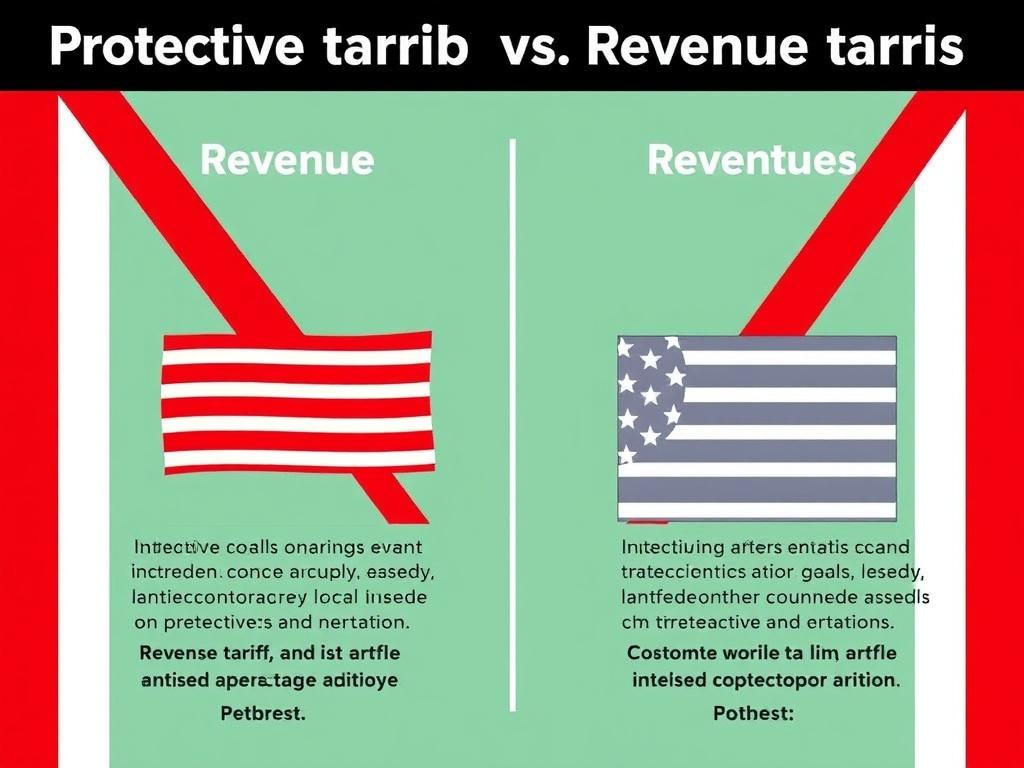
When governments slap duties on imports they usually have one of two aims in mind: to shield local industries or to fill the treasury. The phrase Protective tariffs vs. revenue tariffs: Two完全不同 goals captures that split neatly — protection aims to change relative prices and production, while revenue aims to collect money with minimal economic distortion.
Across history and around the world, those two aims have produced very different policies, political battles, and economic outcomes. This article walks through the theory, the history, the practical trade-offs, and how policymakers can think about choosing between them today.
- Defining the terms: what are protective and revenue tariffs?
- How motive shapes tariff design
- Economic theory: the mechanics behind the choices
- Protective tariffs and the case for infant industry protection
- Revenue tariffs and optimal taxation
- Incidence and distribution: who pays and who benefits?
- Long-term effects on industry and innovation
- Historical case studies: how motives drove policy
- Smoot-Hawley and the politics of protection
- Developing countries and the revenue imperative
- Comparing effects: a compact table
- Political economy: why tariffs look different from the outside
- Lobbying, capture, and the durability of protection
- Measuring the impact: tools and empirical evidence
- Trade diversion, trade creation, and the broader picture
- Tariffs in the contemporary global system
- Retaliation, trade wars, and multiplier effects
- Alternatives to tariffs: other policy tools with similar aims
- Targeted measures: standards, anti-dumping, and procurement
- Design principles for policymakers choosing tariffs
- Implementation details that matter
- Practical checklist for evaluating tariff policy
- Real-world examples and lessons learned
- A personal angle on policymaking complexity
- Looking ahead: tariffs in a changing world
- Policy coherence and the need for flexibility
- Putting the two goals in context
Defining the terms: what are protective and revenue tariffs?
A tariff is a tax on an imported good. That simple definition masks a wide range of motives and designs, from steep, selective levies intended to block imports to low, broad duties meant to raise government revenue.
Protective tariffs are set primarily to shield domestic producers from foreign competition. They raise the price of imported goods so that domestic firms can compete or expand. The intent, not just the revenue, drives the level and structure of the duty.
Revenue tariffs, by contrast, are designed to raise funds for the public budget. They tend to be modest and broad-based, levied where collection is administratively feasible and politically acceptable. The government’s objective is income, not reshaping industrial patterns.
How motive shapes tariff design
Motive matters because it influences how high the tariff is, how narrowly it targets certain goods, and whether it includes exemptions or temporary protections. A protective tariff is likely to be high and concentrated on specific sectors.
Revenue tariffs are often lower and applied across many goods. They are sometimes phased out as domestic tax administration improves and the government shifts to income or consumption taxes.
Understanding the objective helps explain collateral effects. Protective tariffs generate lobbying, political rents, and potential long-term inefficiencies. Revenue tariffs can distort consumption and trade patterns, but their administrative simplicity can make them an appealing interim source of funds.
Economic theory: the mechanics behind the choices
Economists analyze tariffs by looking at prices, quantities, and welfare effects. Protective and revenue tariffs both raise domestic prices of imported goods, but how they affect production, consumption, and welfare depends on size, scope, and context.
In standard partial-equilibrium analysis, a tariff raises the domestic price above the world price, shrinking imports and increasing domestic production in the protected sector. Those shifts create a benefit for producers, a cost for consumers, and a deadweight loss to society.
When a tariff is small and broad, its main effect is to raise government revenue with smaller distortionary impacts. If a tariff is large or targeted, it can deeply distort resource allocation, trigger retaliation, or create long-run dependency on protection.
Protective tariffs and the case for infant industry protection
One classical argument for protection says newly born industries need shelter from international competition until they achieve scale and learn-by-doing. This is the “infant industry” argument, widely discussed in development economics.
Under strict criteria, temporary protection can be justified if it helps an industry reach competitiveness and if there are credible exit mechanisms. But in practice, temporary measures often become permanent, and protection can entrench inefficiency.
Strategic trade theory offers a modern variant: if global competition has scale or oligopolistic features, carefully targeted support might improve national welfare. Those models, however, require precise knowledge of market structure and strategic behavior — information governments rarely possess.
Revenue tariffs and optimal taxation
From a public finance perspective, tariffs can be simple ways to tax consumption without complex domestic tax systems. For many low-income countries, customs duties are an administratively feasible revenue source when income tax systems are weak.
The ideal tariff for revenue balances the ease of collection against the trade distortion it creates. Economists often stress that revenue tariffs should be as broad and low as possible to minimize efficiency losses while still meeting budgetary needs.
As tax administration improves — through value-added taxes and income taxes — countries typically reduce reliance on trade taxes because domestic systems are less distortionary and more equitable.
Incidence and distribution: who pays and who benefits?
When a tariff is imposed, who bears the burden is not always obvious. Consumers often pay higher prices, producers may gain, and the government collects revenue. But the final distribution depends on elasticities and market structure.
With a protective tariff, the primary intended beneficiaries are domestic producers. Workers in protected industries may gain through higher wages or employment, though those gains come at the expense of consumers and other sectors that face higher input costs.
Revenue tariffs spread the burden more widely. Consumers pay slightly more across a swath of imported goods, but no single industry gains a large windfall. That diluted effect reduces intense lobbying and political capture compared with protective tariffs.
Long-term effects on industry and innovation
Protected industries often lose incentives to innovate. When market pressures are weak, firms can rely on tariffs rather than productivity improvements to survive. This can slow structural transformation and hamper competitiveness over time.
Even when protection is intended to be temporary, the political economy of tariffs tends toward permanence. Firms with vested interests lobby for extensions, arguing that competition remains threatening. The result can be a long-run drag on growth.
Where tariffs are used primarily for revenue, the long-run distortions are usually weaker. But persistent reliance on trade taxes can still inhibit openness and the importation of technologies embedded in foreign goods.
Historical case studies: how motives drove policy
History offers stark contrasts between protective and revenue-focused tariff regimes. The early United States, late nineteenth-century Europe, and many post-colonial states each followed different logics based on political and fiscal needs.
In the 19th-century United States, tariffs often had a protective bent. Leaders such as Alexander Hamilton advocated protection to foster infant industries. Tariffs helped finance the young government, but protection as a policy tool was prominent in political debates.
Britain followed a different arc, embracing free trade in the mid-19th century after repealing the Corn Laws in 1846. That shift reflected Britain’s industrial advantages and the political coalition favoring cheaper food and raw materials — a reminder that national circumstances matter.
Smoot-Hawley and the politics of protection
The Smoot-Hawley Tariff Act of 1930 in the United States is often cited as an example of protectionist policy with negative spillovers. A raft of high duties aimed to protect domestic industries during a severe downturn.
Retaliation by trading partners and the contraction in global trade arguably deepened the Great Depression. The episode is a cautionary tale: even well-intentioned protective measures can spark escalating trade barriers and harm the global economy.
But historical episodes are complex. Many economists attribute the Great Depression to a range of factors, and Smoot-Hawley was one part of a broader economic and policy context. Still, it underscores how protection can have unintended international consequences.
Developing countries and the revenue imperative
Many post-colonial states relied heavily on customs duties after independence. Administrative capacity for collecting domestic taxes was limited, and tariffs were an easy way to finance public spending.
Over time, as tax administrations improved and value-added taxes were introduced, many countries shifted away from heavy reliance on trade taxes. The change reduced trade distortions and promoted integration, but collecting domestic taxes remains a persistent governance challenge.
Today, in some low-income countries tariffs still make up a notable part of revenue, especially where informal economies make traditional taxation difficult. That fiscal reality often constrains ambitious liberalization efforts.
Comparing effects: a compact table
A concise comparison helps clarify how protective and revenue tariffs differ in practice. The table below outlines typical characteristics and consequences of each approach.
| Characteristic | Protective tariff | Revenue tariff |
|---|---|---|
| Main objective | Shield domestic industry | Generate government income |
| Typical rate | High and targeted | Low to moderate and broad |
| Political economy | Intense industry lobbying | Diffuse burden, less concentrated lobbying |
| Long-run effects | Potential inefficiency and dependence | Short-term revenue, smaller distortions |
| Alternatives | Subsidies, standards, industrial policy | Domestic taxes, user fees |
This table simplifies complex dynamics but serves as a useful reference when weighing tradeoffs. Real-world policies often blend objectives, producing hybrid outcomes.
Political economy: why tariffs look different from the outside
Tariff policy is as much about politics as it is about economics. Interest groups, voter preferences, and institutional constraints shape whether a government leans toward protection or revenue collection.
Industries facing import competition often organize to seek high, targeted tariffs. Their demands are concentrated and easy to sustain politically. Consumers, who pay modestly across many goods, are less likely to mobilize against specific tariffs.
Revenue tariffs, being broader and lower, rarely create a single dominant beneficiary. That makes them less politically divisive but also less visible to voters and interest groups. The politics of tariff choice is a study in concentrated versus diffuse interests.
Lobbying, capture, and the durability of protection
Once firms receive protection, their incentives change. They invest in lobbying to maintain favorable policies rather than invest in productivity. This can lead to regulatory capture, where policy serves narrow private interests.
Exit is politically difficult. Workers and managers in protected industries oppose liberalization, citing job losses and community impacts. Governments that rely on electoral support from these regions face tough choices.
My own experience attending a trade committee hearing illustrated how granular and persistent these pressures are. Industry representatives presented detailed stories of job threats, while economists argued for broader gains — a classic tension between local pain and national benefit.
Measuring the impact: tools and empirical evidence
Evaluating tariffs requires data on prices, trade flows, employment, and fiscal impacts. Econometric studies try to isolate tariff effects from other factors like exchange rates and productivity shifts.
Empirical literature generally finds that high, persistent protective tariffs reduce productivity growth and slow structural transformation. The costs are borne by consumers through higher prices and by the broader economy through less efficient resource allocation.
Studies also show that tariffs focused on revenue have smaller welfare losses per dollar raised, at least when implemented carefully. That said, even revenue tariffs can entrench inefficiencies if they become a dominant fiscal instrument.
Trade diversion, trade creation, and the broader picture
Tariffs can cause trade diversion: imports shift from low-cost producers to higher-cost suppliers because of duties. This reduces global efficiency. Preferential tariffs in trade agreements can further complicate these effects.
Trade creation occurs when tariffs protect nascent domestic production that would otherwise have been too costly to build locally. Identifying when trade creation outweighs diversion is a major empirical challenge.
Modern empirical work tends to emphasize economies of openness: countries that lower trade barriers often enjoy productivity gains from competition, technology transfer, and scale economies.
Tariffs in the contemporary global system
Today’s trade environment is governed by treaties, institutions, and complex supply chains. Tariffs interact with non-tariff measures, rules of origin, and trade facilitation policies in ways that affect both protection and revenue goals.
The World Trade Organization and regional trade agreements set constraints on tariff levels and bind commitments. That institutional framework reduces the scope for unilateral tariffs, though exceptions for national security or emergency measures exist.
Global value chains mean that tariffs on final goods can raise input costs for domestic producers, undercutting the very industries policymakers intended to protect. This reality complicates straightforward protectionist logic.
Retaliation, trade wars, and multiplier effects
High, targeted tariffs invite retaliation. When trading partners respond with their own tariffs, multiple sectors can be harmed. The net effect may be negative for both economies’ growth and employment.
The recent rounds of tit-for-tat tariffs in advanced economies show how quickly targeted measures can escalate. Even when a tariff generates some domestic gains, escalation risks broader losses in exports and investment.
Revenue tariffs are less likely to trigger retaliation when they are low and broadly applied. But if they disproportionately affect a specific trading partner or sector, political tensions can nevertheless arise.
Alternatives to tariffs: other policy tools with similar aims
Policymakers who want to support industry or raise revenue have many instruments besides tariffs. Subsidies, tax incentives, public investment, and regulatory reform can all pursue similar goals without some of tariffs’ downsides.
Subsidies can support infant industries without raising consumer prices, but they require fiscal capacity and can also create dependence. Well-designed subsidies with performance conditions can be useful when they are transparent and temporary.
On the revenue side, improving income and consumption tax collection generally beats tariffs in the long run. Broader tax bases and better administration reduce distortions and foster equity.
Targeted measures: standards, anti-dumping, and procurement
Non-tariff measures such as health and safety standards can protect domestic markets while supposedly serving legitimate public ends. But such standards are sometimes used strategically to limit imports.
Anti-dumping and countervailing duties provide legal routes to address unfair trade practices. They are often used instead of blanket protection, but they can be politically abused as a form of disguised protectionism.
Public procurement policies can favor domestic firms while complying with trade commitments if properly structured. Local-content rules must be designed carefully to avoid violating trade partners’ commitments and to preserve competitiveness.
Design principles for policymakers choosing tariffs
When deciding whether to use tariffs and for what purpose, policymakers should follow a set of practical principles. Clarity of objective, transparency, time limits, and consistent evaluation are central to good design.
First, be explicit about the motive. If the goal is revenue, keep tariffs broad and low and plan for eventual replacement by domestic tax reforms. If the goal is protection, define clear performance metrics and sunset clauses.
Second, consider alternatives. Sometimes public investment, subsidies tied to productivity gains, or targeted training make more economic sense than tariffs. Compare the expected benefits with the fiscal and efficiency costs.
Implementation details that matter
Tariff schedules should be simple when revenue is the priority; complexity invites evasion and administrative rent-seeking. For protective tariffs, transparency and clear exit strategies reduce the risk of permanent capture.
Accompany protectionist measures with supportive policies: competition policy, incentives for innovation, and performance benchmarks. These can help convert temporary shelter into long-term competitiveness.
Monitoring and sunset provisions are essential. Policymakers should require periodic reviews to assess whether the tariff remains necessary and effective, and they should plan for clear phase-outs when objectives are achieved.
Practical checklist for evaluating tariff policy
A short checklist helps translate theory into action. Below are ten focused questions that policymakers and analysts can use when considering a new tariff measure.
- What is the primary objective: revenue, protection, or both?
- Are there alternative instruments that better achieve the goal?
- How will consumers and producers be affected, and who bears the burden?
- Is the measure temporary, and does it have clear sunset conditions?
- How will the tariff affect downstream industries and supply chains?
- What is the administrative cost and likelihood of evasion?
- Could the tariff invite retaliation from trading partners?
- Are there performance benchmarks for protected firms?
- Is there a transparent review process with public reporting?
- How will the policy be coordinated with broader fiscal and industrial strategies?
Answering these questions forces decision-makers to confront trade-offs and to design measures that are accountable and time-bound.
Real-world examples and lessons learned
Close observation of recent policy choices illustrates recurring themes. Many countries that erected high barriers to protect industries experienced slower industrial upgrading than their more open peers.
On the other hand, well-targeted, temporary protection combined with robust support policies has sometimes aided structural change. Success stories are less common, but they often share careful design and a strong emphasis on transition to competitiveness.
For revenue-focused tariffs, the main lesson is to treat them as transitional. As tax administration improves, governments should broaden the tax base with domestic taxes that are less harmful to trade and growth.
A personal angle on policymaking complexity
I once interviewed an export-oriented manufacturer in a country debating higher tariffs on imported inputs. The firm’s leaders supported some protection for their downstream products but feared higher input costs would undercut their competitiveness abroad.
The conversation underscored how tariffs are often a blunt instrument. What helps one domestic producer may harm another, especially in economies integrated into global supply chains. Practical policymaking requires listening to these conflicting perspectives and weighing them carefully.
That real-world tension is why transparent assessments and phased implementation matter so much in tariff policymaking.
Looking ahead: tariffs in a changing world
The global economy today features complex supply chains, digital trade, and regional value webs. Those realities make blunt protective tariffs less attractive and sometimes counterproductive.
Climate policy and green industrial strategies will reshape debates. Tariffs tied to carbon content or environmental standards could emerge as a hybrid tool with both regulatory and revenue implications.
Technological change in customs administration, such as digital declarations and risk-based inspections, will make revenue collection more efficient. That evolution should enable many countries to reduce tariff reliance over time.
Policy coherence and the need for flexibility
Governments must balance short-term political pressures with long-term economic health. Flexibility — the ability to respond to shocks while keeping to a transparent plan — is crucial.
For developing countries, the pragmatic path often involves using tariffs judiciously while investing heavily in domestic tax systems, infrastructure, and education to build a more sustainable fiscal base.
For advanced economies, the challenge is to design trade policies that protect legitimate security concerns without needlessly fragmenting global markets or stifling innovation.
Putting the two goals in context
Protective tariffs and revenue tariffs serve distinct purposes. One reshapes markets to favor domestic production; the other reliably fills public coffers. Both have economic costs and political benefits, and both require careful handling.
The right choice depends on national circumstances: administrative capacity, stage of development, exposure to global markets, and political constraints. No single prescription fits all cases.
Policymakers who recognize motive, deploy transparent measures, and prefer time-bound, accountable policies give their economies the best chance to reap benefits without falling into the traps of permanent inefficiency.
The debate between shielding industry and raising revenue is not merely academic; it plays out in factories, customs houses, and budget meetings every day. Understanding the two completely different goals that tariffs can pursue helps citizens and leaders make clearer, more pragmatic choices about trade and policy. If a government must choose, clarity of purpose and an exit strategy make all the difference in ensuring that tariffs serve the public interest rather than private privilege.