The relationship between tariffs and currency exchange rates can feel like a knot of policy, markets, and human behavior — tight, messy, and full of hidden loops.
In this article I’ll unpack the mechanisms that connect trade barriers to exchange-rate moves, examine theory and evidence, and walk through real-world episodes that reveal how tariffs play out in currency markets.
- Why tariffs matter beyond the border
- Simple channels: from duty to dollar
- Direct trade balance channel
- Pass-through and price adjustments
- Expectations, risk, and capital flows
- Monetary policy interactions
- When the currency does the heavy lifting
- Real versus nominal exchange rates
- The Marshall-Lerner and J-curve effects
- Modeling the link: simplified frameworks
- Mundell-Fleming intuition
- General equilibrium and distributional effects
- Empirical evidence: what history shows
- Smoot-Hawley and the Great Depression
- The 2018–2019 U.S.–China tariff episode
- Case studies: patterns and surprises
- Mexico during NAFTA renegotiation
- EU and steel tariffs
- China’s occasional FX adjustments
- Channels summarized: a compact reference
- How firms and investors respond
- Hedging and invoicing decisions
- Supply-chain reconfiguration
- Policy implications for governments
- Strategic use and limitations
- Legal and diplomatic fallout
- Measuring the likely FX impact of a proposed tariff
- Limitations of the link: when tariffs don’t move currencies
- Practical advice for businesses and investors
- How markets priced tariff risk in my experience
- Tools and models for analysts
- Key indicators to monitor
- Longer-run structural effects
- Risks and unintended consequences
- Putting it all together: a step-by-step thought experiment
- Final thoughts and practical takeaways
Why tariffs matter beyond the border
Tariffs are often presented as blunt instruments: a tax on imports meant to protect domestic industries or improve the trade balance. That description is true, but incomplete.
When a government levies a tariff it doesn’t only change the price of goods. It alters incentives for buyers and sellers, shifts expected profits, and nudges capital and currency flows — all of which can feed into exchange rates in short and long timeframes.
Understanding the channels between tariffs and exchange-rate moves helps policymakers, exporters, importers, and investors anticipate second‑order effects that can outweigh the initial tariff impact.
Simple channels: from duty to dollar
At its most direct, a tariff raises the domestic-currency price of imported goods or lowers the foreign-currency revenue of exporters when exporters absorb some of the tariff. Either way, relative prices change.
Higher domestic prices for imports can reduce import demand, shrinking the outflow of domestic currency needed to pay for foreign goods. That reduction could push the domestic currency to appreciate, all else equal.
Conversely, if tariffs trigger retaliation and cut exports, foreign buyers demand less of the domestic currency to pay for those exports, which can lead to depreciation. The net effect depends on the balance of these opposing forces.
Direct trade balance channel
The traditional textbook story links tariffs to the current account. By reducing imports or changing the terms of trade, tariffs can improve a country’s trade balance and thus its net demand for foreign currency.
If imports fall more than exports, fewer domestic currency units are sold for foreign currency, reducing supply of domestic currency in FX markets and supporting appreciation. However, this depends on elasticities: if import demand is inelastic, import spending might not fall much.
Pass-through and price adjustments
A crucial determinant is how much of the tariff gets passed to consumers versus absorbed by producers. Full pass-through raises domestic prices and reduces real purchasing power, which can dampen import demand.
Incomplete pass-through leaves exporters or retailers absorbing costs, squeezing margins rather than adjusting trade flows. That can blunt the tariff’s immediate effect on the currency.
Expectations, risk, and capital flows
Tariffs don’t act in a vacuum. Announcements and uncertainty matter. Financial markets price expected future profits, inflation, and policy responses — all of which affect capital flows and exchange rates.
A sudden tariff shock can trigger risk-off moves: investors may pull money from affected countries or sectors, selling the domestic currency and causing depreciation. Alternatively, if tariffs are paired with fiscal tightening, markets might buy the currency in anticipation of higher interest rates.
Thus, capital-flow responses often dominate the immediate currency reaction, even when trade flows adjust only slowly.
Monetary policy interactions
Central banks respond to tariffs through interest-rate decisions or interventions. If tariffs raise inflation, central banks might tighten policy, which would attract capital and buoy the currency.
But if tariffs slow growth, monetary easing could follow, exerting downward pressure. The interaction between tariff-induced price changes and monetary responses is a major source of variability across episodes.
When the currency does the heavy lifting
Sometimes exchange rates adjust in lieu of physical trade reallocation. If a country’s currency depreciates after a trading partner raises tariffs, exporters in the tariffed country become cheaper on world markets, partially offsetting the tariff’s effect.
This price-adjustment mechanism is both a buffer and a source of tension: it cushions importers and exporters against tariff shocks, but it also transmits those shocks to third countries and to domestic inflation.
Real versus nominal exchange rates
Nominal exchange rates measure the number of units of one currency per another. Real exchange rates adjust for price levels. Tariffs directly affect relative prices, so the real exchange rate often captures their effect more accurately.
A tariff that raises domestic prices will tend to appreciate the real exchange rate even if the nominal rate moves little, thereby easing external adjustment and potentially elongating the policy shock.
The Marshall-Lerner and J-curve effects
Economic theory provides conditions for whether a depreciation improves the trade balance. The Marshall-Lerner condition requires that the sum of absolute export and import demand elasticities exceed one.
Empirically, trade balances often follow a J-curve after a currency change: the balance worsens initially as contracts run off at old prices, then improves as quantities adjust. Tariffs can interact with these dynamics, causing delayed currency effects.
Modeling the link: simplified frameworks
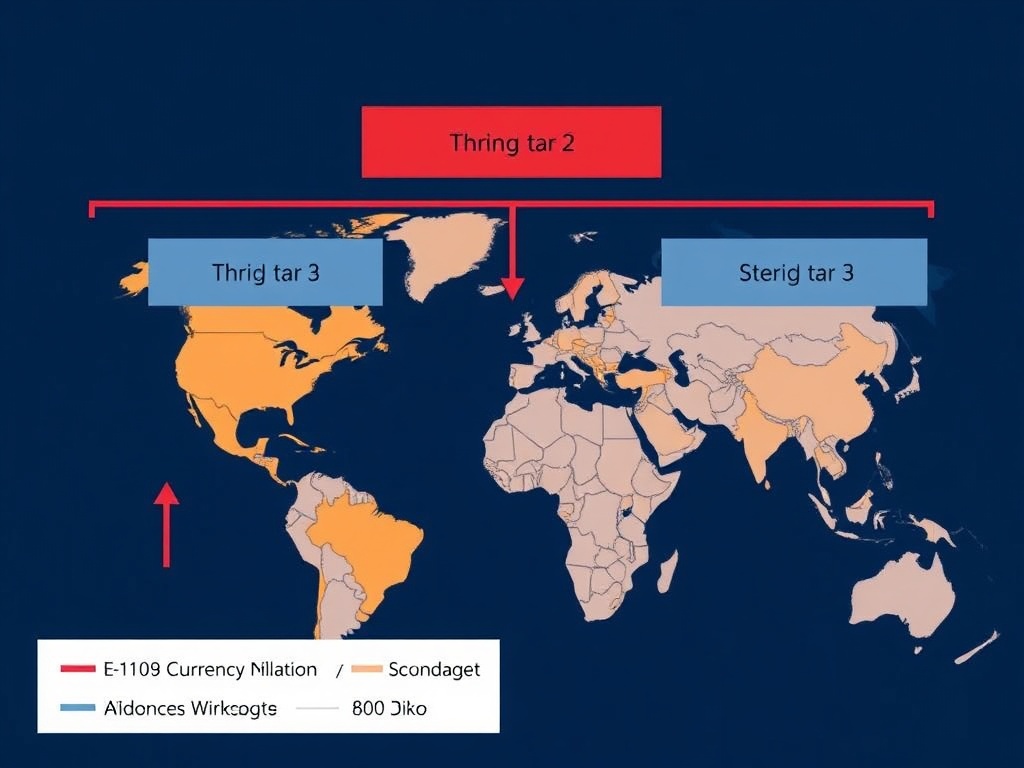
Several theoretical frameworks illuminate the relationship between tariffs and exchange rates, from small open‑economy models to two-country general equilibrium settings. Each highlights different channels and assumptions.
At a basic level, a two-country model with monopolistic competition shows how tariffs alter markups and trade flows, generating exchange-rate adjustments through changes in demand for currencies. More elaborate models add capital mobility and sticky prices.
Understanding assumptions — price flexibility, capital mobility, and market structure — is essential because they determine whether currencies absorb part of the shock or amplify it.
Mundell-Fleming intuition
In the short run under high capital mobility, monetary policy plays a central role. Mundell-Fleming suggests that exchange rates and interest rates adjust rapidly when capital flows react to policy or risk changes.
A tariff that provokes capital flight will push the exchange rate independently of the trade balance. If a central bank tries to defend the currency, it may need to change rates or use reserves, altering the policy trade-off.
General equilibrium and distributional effects
General equilibrium models highlight that tariffs change income distribution: import-competing sectors may gain, consumers lose, and exporting sectors can be hit by retaliation. These income shifts affect saving and investment, further influencing exchange rates.
Because tariffs are sectoral, the aggregate currency response depends on the size and trade intensity of affected industries, not just headline tariff rates.
Empirical evidence: what history shows
Empirical research finds mixed but informative patterns. Tariff changes often lead to currency adjustments, but the direction and magnitude vary with context and policy responses.
Studies of tariff episodes typically report incomplete pass-through and significant roles for capital flows and policy expectations. In many modern episodes, exchange-rate channels partially offset tariff effects, but not completely.
Smoot-Hawley and the Great Depression
Historically, the Smoot-Hawley tariffs of the 1930s are invoked as a cautionary tale. Those tariffs coincided with collapsing trade and deep economic contraction, and exchange-rate disorder was part of the broader crisis.
While the macroeconomic environment then was exceptional — with gold‑standard constraints and global deflation — the episode reminds us that protectionist shocks can interact with fragile financial conditions to produce large currency and economic effects.
The 2018–2019 U.S.–China tariff episode
The tariff standoff between the United States and China offers a modern laboratory. Tariffs were layered on a wide range of goods, creating uncertainty and prompting firms to restructure supply chains in some cases.
Currency moves were nuanced: the Chinese renminbi weakened at points, reflecting capital outflows and growth concerns. At the same time, global risk sentiment and monetary policy played major roles, complicating attribution solely to tariffs.
For importers and exporters I interviewed during that period, exchange-rate hedging became a near-constant task. Some firms reduced foreign-currency exposure; others shifted sourcing and invoicing currency to mitigate risk.
Case studies: patterns and surprises
Individual episodes illuminate how local conditions and timing shape outcomes. Below are a few illustrative cases with different mechanisms at work.
Mexico during NAFTA renegotiation
Political rhetoric and threat of tariffs contributed to volatility in the Mexican peso, especially around announcements. The currency’s moves reflected both trade disruption risk and shifts in investor sentiment toward emerging-market assets.
Capital flows and risk premia were important. Investors reassessed Mexico’s political risk, which fed into FX directly, even when actual tariff changes were limited or temporary.
EU and steel tariffs
When tariffs on steel were proposed and implemented, affected currencies in some exporting countries depreciated modestly. The changes were driven by concerns about export demand and the potential for retaliatory measures.
Here, the sectoral concentration of the tariffs mattered: economies heavily reliant on affected exports saw larger FX responses than more diversified ones.
China’s occasional FX adjustments
China has at times allowed more depreciation when external conditions deteriorated, using exchange-rate flexibility to preserve export competitiveness in the presence of trade tensions. This demonstrates how exchange-rate policy can be an active tool to absorb shocks.
But such moves also raise capital-flow pressures and domestic inflation concerns, forcing a delicate balancing act for policymakers.
Channels summarized: a compact reference
To keep the mechanics clear, here’s a compact summary of the main channels through which tariffs influence currencies.
| Channel | Direction of potential FX effect | Key condition |
|---|---|---|
| Trade balance (import reduction) | Appreciation | Large, sustained drop in imports |
| Export reduction (retaliation) | Depreciation | Significant export share affected |
| Capital flows (risk off) | Depreciation | Investor risk aversion or uncertainty spike |
| Monetary tightening (inflation response) | Appreciation | Central bank credible and faster to act |
| Pass-through to prices | Real appreciation | High pass-through, sticky nominal FX |
How firms and investors respond
Businesses don’t wait for macro models to settle. They hedge, reprice, and reroute. In practice, the immediate corporate response can shape the currency outcome just as much as policy moves.
Importers may shift sourcing, renegotiate contracts, or change invoicing currencies to reduce exposure. Exporters may dip into FX hedges, adjust prices abroad, or seek new markets.
Hedging and invoicing decisions
When tariffs raise uncertainty about future exchange-rate moves, hedging demand rises. This can temporarily increase demand for forward contracts and options, shifting near-term FX liquidity and rates.
Invoicing currency matters too. If exporters invoice in foreign currency, they transfer FX risk to buyers; if they invoice in local currency, they bear it themselves, which can change their pricing behavior under tariffs.
Supply-chain reconfiguration
Tariffs encourage supply‑chain adjustments that can take months or years. Firms may relocate production, source inputs from tariff-free countries, or increase local content — moves that change trade patterns and long-term currency demand.
These structural shifts may reduce the initial currency impact of tariffs, but they also create winners and losers within economies, influencing political support for trade policy and monetary responses.
Policy implications for governments
Policymakers should recognize that tariffs interact with exchange-rate policy and capital flows. A tariff’s ostensible protection can be partially offset by currency moves, and unintended consequences may follow.
Coordination between fiscal, trade, and monetary authorities matters. Clear communication and careful calibration can reduce disruptive volatility and help target the intended economic effects.
Strategic use and limitations
Tariffs can be used strategically to protect infant industries or respond to unfair trade practices, but currency regimes limit their effectiveness. Countries with fixed or tightly managed rates may find tariffs less potent or more costly.
Moreover, tariffs that provoke large capital‑flow swings may force central banks into difficult choices between defending exchange rates and pursuing domestic objectives like price stability or full employment.
Legal and diplomatic fallout
Beyond economics, tariffs can trigger disputes in institutions such as the World Trade Organization or prompt retaliatory measures that alter trade and currency dynamics. Diplomatic risk should therefore be part of any assessment.
Retaliation that targets high‑value exports can create asymmetric currency pressures, putting more strain on countries with concentrated export baskets.
Measuring the likely FX impact of a proposed tariff
Analysts use several practical steps to estimate how a tariff might affect exchange rates. No forecast is guaranteed, but structured analysis reduces surprises.
- Assess the share of imports affected and likely change in quantity demanded.
- Estimate pass-through to domestic prices and the likely inflation response.
- Model capital-flow sensitivity and potential risk-premium shifts.
- Simulate monetary-policy reactions given central-bank objectives and credibility.
- Consider supply-chain responses and time lags for structural adjustments.
This checklist helps separate immediate financial-market impacts from slower real-economy adjustments that change currency fundamentals over months and years.
Limitations of the link: when tariffs don’t move currencies
There are many cases where tariffs barely budge exchange rates. High-pass-through environments, floating exchange-rate regimes with offsetting capital flows, or small, targeted tariffs often have muted FX effects.
Additionally, when markets expect tariffs to be temporary, they price in transitory effects and wait for more durable policy signals before moving exchange rates substantially.
Practical advice for businesses and investors
Start by mapping your exposures. Which currencies, suppliers, and customers would be affected by a tariff shock? Quantify exposures and stress test under several scenarios.
Use hedging prudently: forwards lock in rates but can be costly if unexpected appreciation occurs. Options provide asymmetric protection but have premiums. Mix instruments depending on your risk tolerance and timeframe.
Consider diversifying supply sources and negotiating contract terms that allow for price adjustments or alternative invoicing currencies. Small changes in procurement strategy can materially reduce FX vulnerability.
How markets priced tariff risk in my experience
As a writer who followed FX desks during trade wars, I saw real-time evidence of how traders priced tariff risk. Announcements caused immediate repricing of risk premia, with forward curves shifting before any actual changes in trade flows.
Importers I spoke with often paid higher hedging costs during peak uncertainty, and some expedited shipments to avoid potential tariff increases — a behavioral response that temporarily raised import demand and produced short-lived currency pressure in the opposite direction of theoretical long-run effects.
Tools and models for analysts
Analysts often blend structural models with event studies. Structural models capture long-run channels, while event studies assess market reactions to announcements and news.
High-frequency FX data combined with trade-news feeds can isolate announcement effects, while vector autoregressions (VARs) and structural identification strategies help separate tariff shocks from contemporaneous monetary or fiscal news.
Key indicators to monitor
- Trade balance and monthly goods import/export data
- Forward exchange rates and implied volatilities
- Capital-flow statistics and sovereign bond spreads
- Inflation expectations and central-bank policy signals
- Industry surveys on pass-through and supply-chain adjustments
Longer-run structural effects
Over years, tariffs can reshape comparative advantage, production networks, and the geographic mix of trade. These structural changes alter long-run currency fundamentals through productivity, terms of trade, and current-account profiles.
For example, if tariffs induce localization of production, a country might import fewer intermediate goods and see a durable shift in its trade composition. Currency effects emerge gradually as global investment patterns adapt.
Risks and unintended consequences
Tariffs can provoke inflation, reduce productivity, and invite retaliation — outcomes that erode the policy’s intended benefits while affecting the currency. Policymakers rarely control all these spillovers.
Another risk is policy inconsistency: surprise tariffs followed by abrupt reversals can undermine credibility, triggering volatile capital flows and larger FX swings than the original tariff would have caused.
Putting it all together: a step-by-step thought experiment
Imagine Country A imposes a 20 percent tariff on an imported intermediate good that accounts for 10 percent of its imports. What happens next depends on several steps.
First, importers decide whether to absorb costs, raise prices, or look for alternative suppliers. Second, exporters who face retaliation may see demand fall. Third, investors reassess risk and potential central-bank responses. Each step unfolds on different timelines and with different intensity.
If import demand proves elastic and import volumes fall substantially, the currency may appreciate. If retaliation hits exports and capital flees, depreciation may dominate. A central bank’s reaction can invert or amplify either outcome.
Final thoughts and practical takeaways
The link between tariffs and currency exchange rates is complex, conditional, and often surprising. No single rule predicts the direction of change because so many moving parts — trade elasticities, pass-through, capital flows, and policy reactions — interact.
For decision-makers, the relevant task is not to assume a fixed outcome but to map scenarios, monitor early-warning indicators, and design flexible hedging and procurement strategies. That approach turns uncertainty from paralysis into manageable risk.
In markets and policy alike, the best defenses are preparation, timely information, and a clear sense of which channels matter most for your particular exposure. With those tools, tariffs become one more variable to manage rather than an uncontrollable force.