The race to electrify transportation has shifted attention from motor factories to the kilowatt-hours inside them. Batteries now sit at the center of supply chains, geopolitical debates, and industry strategy, and governments are wrestling with whether to use tariffs and other trade tools to shape that future.
- Why batteries matter beyond the car
- How import duties on batteries would work in practice
- The global battery supply chain: stages and chokepoints
- Economic impacts for producers and countries
- National security, resilience, and industrial strategy
- Environmental trade-offs and lifecycle impacts
- Case studies: how different regions are approaching battery trade
- United States
- European Union
- China
- How automakers respond to trade barriers
- Impacts on consumers and EV adoption
- Policy alternatives and complementary measures
- Legal and diplomatic risks of imposing duties
- Financial and investment considerations
- Workforce and regional development effects
- Recycling, second-life batteries, and circular economy impacts
- Practical examples and real-world trade-offs
- Scenario planning: timelines and possible futures
- Recommendations for prudent policy design
- How automakers and suppliers can prepare
- A quick comparative table of illustrative tariff scenarios
- Public opinion and political economy
- International cooperation as a force multiplier
- How to measure success
- Personal perspective from industry conversations
- What to watch next
- A pragmatic way forward
Why batteries matter beyond the car
Electric vehicle batteries are not just components; they are the factories’ competitive edge, the raw-materials market driver, and often the single most expensive part of an EV. Their chemistry, scale, and place of manufacture determine cost, range, recyclability, and the emissions profile of a vehicle over its lifetime.
Because a battery’s economic and environmental footprint accumulates long before it reaches an assembly line, countries see strategic value in hosting the processing, cell production, and recycling capacity. That strategic value is why trade measures aimed specifically at these cells or packs carry outsized consequences.
When policymakers talk about industrial policy for the 21st century, batteries are the test case. Subsidies and procurement are part of the story, but import duties also appear on the policy table because they influence where companies choose to build and source for decades.
How import duties on batteries would work in practice
At their simplest, tariffs are taxes on imported goods. Applied to battery cells or packs, they raise the landed cost of foreign-made units for automakers that rely on cross-border sourcing. That price change can prompt immediate adjustments in procurement and long-term shifts in investment.
Tariffs can be structured in different ways: ad valorem (a percentage of value), specific rates (a set amount per kilowatt-hour or per unit), or hybrid schemes. The shape of the tariff matters because batteries are rapidly dropping in price; a percentage-based duty moves with market prices, while a kWh-specific levy can become a larger or smaller share over time.
Trade agreements and World Trade Organization rules set limits and procedures. Unilateral duties can provoke retaliation or legal challenges, while exemptions for certain materials or countries complicate compliance and encourage tariff engineering—where parts are routed through third countries to avoid duties.
The global battery supply chain: stages and chokepoints

Understanding tariffs requires a clear view of the supply chain. Broadly, it runs from mining and refining of lithium, cobalt, nickel, and graphite to precursor chemicals, to cathode and anode production, then cell assembly, pack integration, and finally vehicle installation. Each stage has different capital and technical requirements.
Certain stages are more geographically concentrated than others. Processing and refining often occur near mining hubs or in countries with specialized chemical industries. Cell assembly tends to cluster where gigafactories have been built. That concentration creates leverage: a tariff aimed at cells may look like a blunt instrument when the true bottleneck is precursor chemicals.
Bottlenecks shift too. A surge in demand for lithium or nickel can turn a previously niche processing step into a global strategic asset. Investors respond to policy signals, which means a tariff introduced today can accelerate or deter investments that change the map of supply chains over the next decade.
Logistics and standards add complexity. Batteries are heavy, hazardous under certain conditions, and subject to safety and transport rules that make long supply routes costly. For automakers, balancing cost, safety, and regulatory compliance is a continuous optimization exercise shaped by trade policy.
Economic impacts for producers and countries
Tariffs can protect emerging domestic industries by giving local producers time to scale without being undercut by lower-priced imports. That protection can attract plant construction and workforce development, creating an industrial base that pays off later in exports and higher-value jobs.
However, protection comes at a cost. Higher input prices reduce global competitiveness for automakers that cannot absorb the increase through margins. Those companies may pass costs to consumers, slow EV rollout, or relocate production to avoid duties, which can hollow out other parts of the value chain.
Smaller economies that serve as processing or assembly hubs may suffer if tariffs reroute investment to protected markets. Conversely, nations with abundant raw materials or specialized processing could gain bargaining power and price advantages if tariffs elsewhere restrict trade.
There are also second-order effects. Suppliers of equipment, engineering services, and logistics tied to battery plants feel the impact of shifts in plant location. Local economies may see job creation in manufacturing but could lose employment in downstream industries if vehicle production migrates away.
National security, resilience, and industrial strategy
Governments frame tariffs partly as instruments of national security. Dependence on a narrow set of foreign suppliers for critical technologies is viewed as a vulnerability—especially when those suppliers are in countries where geopolitical competition is high.
Tariffs can be paired with incentives to onshore manufacturing or to encourage friendly partners to build facilities. That approach seeks supply-chain resilience through redundancy, not isolation. But resilience has a price; duplicative capacity is more expensive than efficient global specialization.
Where countries are anxious about control over critical minerals and battery-grade chemicals, duties can signal seriousness and galvanize investment in domestic processing or recycling. Policymakers must weigh that strategic signal against the economic cost and the risk of trade disputes.
Environmental trade-offs and lifecycle impacts
Many advocates of tariffs claim environmental benefits: keeping production local could reduce shipping emissions and allow stricter environmental standards on manufacturing. In theory, that would ensure cleaner cell production and better recycling practices.
In practice, the outcome depends on where facilities are built and how they are regulated. A tariff that pushes production to a country with weaker environmental oversight could worsen global emissions. Conversely, it might promote cleaner production if the importing market couples tariffs with high environmental standards and incentives for low-carbon manufacturing.
Recycling deserves special attention. Domestic recycling can reclaim valuable metals and reduce the need for new mining. Tariffs that encourage near-market recycling can shorten material loops, but only if recycling capacity is actually developed and operated under strong environmental controls.
Case studies: how different regions are approaching battery trade
Policy approaches vary because industrial priorities, geopolitical context, and domestic industry strength differ. Here are snapshots of three major actors and what they reveal about the range of choices available.
United States
The U.S. has combined tariffs and investment incentives in recent years to promote domestic battery and EV manufacturing. Federal subsidies aim to encourage cell production and chemical processing, while procurement rules and Buy America provisions influence public fleet purchases and infrastructure projects.
Trade measures have been discussed as ways to discourage offshoring of critical components. Yet the approach balances open trade with targeted support; aggressive tariffing risks inflaming tensions with allies who are also vying for battery investment.
European Union
The EU favors a mix of local content requirements, subsidies, and regulatory standards to build a circular battery ecosystem. It has emphasized environmental and labor standards alongside industrial policy, trying to make Europe attractive for sustainable manufacturing rather than relying on tariffs alone.
Because the EU relies on imports for many battery inputs, its strategy focuses on diversifying suppliers, supporting European gigafactories, and developing recycling legislation that strengthens domestic value capture while remaining compatible with trade rules.
China
China’s industrial model has been to deeply integrate its supply chain, from mining partnerships to chemical processing and finished cells. That vertical integration has allowed Chinese firms to scale and reduce unit costs in ways that are hard to replicate quickly elsewhere.
Beijing’s support has included subsidies, local content incentives, and investments in overseas mining. Other countries’ tariffs respond in part to this success, but erecting trade barriers against such a dominant supplier is politically and economically fraught.
How automakers respond to trade barriers
Automakers manage tariffs through multiple levers: reshoring production, diversifying suppliers, redesigning battery packs to use different chemistries, and engaging in tariff engineering to minimize duty exposure. These strategies have costs and trade-offs.
Reshoring requires capital and specialized labor, and it can take years before a new plant achieves the same cost structure as an incumbent. Diversifying suppliers reduces concentration risk but increases complexity in procurement and quality control.
Some firms invest in modular pack designs that can accommodate cells from multiple manufacturers, reducing dependency on a single source. Others partner with local firms or form joint ventures that qualify for favorable tariff treatment or local content exemptions.
Impacts on consumers and EV adoption
Tariffs generally raise the cost of imported goods, and batteries are a large share of EV cost. Higher battery prices can translate directly into higher vehicle prices, slowing adoption, especially among price-sensitive buyers and in emerging markets.
But the relationship is not one-to-one. Subsidies, tax credits, and manufacturer absorption of costs can blunt price increases. Still, in a market where affordability is key to broad adoption, any policy that raises costs must be paired with measures that preserve demand.
Consumer sentiment also matters. If tariffs signal a long-term commitment to local manufacturing and better environmental standards, they can stimulate demand among buyers who value domestic supply chains and sustainable production.
Policy alternatives and complementary measures
Tariffs are just one tool. Policymakers can choose from a menu of alternatives that often have fewer trade-offs and can be more targeted in achieving policy goals.
- Direct subsidies to cell manufacturing and processing.
- Tax credits for domestic sourcing of battery components.
- Public procurement preferences that reward local suppliers without explicit duties.
- Grants and loans for recycling and secondary processing facilities.
- Standards and certification programs to ensure low-carbon production.
Combining measures can protect nascent industries while keeping costs manageable. For example, a phase-in of localized content requirements, supported by R&D grants and workforce training, can build capacity without sudden disruptions to vehicle prices.
Legal and diplomatic risks of imposing duties
Tariffs can trigger retaliation, with trading partners imposing their own duties on exports that matter to the initiating country. Retaliation can escalate beyond batteries to autos, agriculture, and other politically sensitive industries.
Trade disputes are also costly. Challenged duties can be taken to the WTO or trigger bilateral negotiations, consuming diplomatic bandwidth and creating uncertainty that deters private investment. The legal framework limits how tariffs can be justified on grounds like national security or anti-dumping.
Policymakers must therefore balance industrial objectives against the likelihood of a trade backlash and the potential for multilateral solutions that accomplish similar goals with less friction.
Financial and investment considerations
Investors look for predictable policy environments before committing large sums to battery plants. Tariffs create both opportunity and uncertainty. A credible, long-term industrial strategy that combines temporary protection with a clear pathway to competitiveness is more likely to attract capital than abrupt, open-ended duties.
Public-private partnerships can reduce risk. Governments can co-invest or offer guaranteed offtake arrangements to anchor capacity, then gradually reduce protections as firms mature. That staged approach aligns public fiscal prudence with private-sector incentives.
Financing sustainability is another lever. Green bonds and targeted lending can channel capital into low-carbon battery manufacturing and recycling, supporting policy aims without relying solely on tariffs.
Workforce and regional development effects
Battery plants require skilled technicians, chemical engineers, and specialists in high-voltage systems. Building that workforce takes time and training. Tariffs that spur local investment can create these jobs, but the quality and longevity of employment depend on the plant’s broader economic integration.
Regions that win gigafactories often benefit from supplier clusters and a multiplier effect in services and construction. Yet those gains can be uneven, and community benefits require planning for housing, education, and infrastructure to sustain growth.
Policymakers should pair industrial incentives with workforce development programs, apprenticeships, and partnerships with technical colleges to ensure that new jobs are accessible to local populations.
Recycling, second-life batteries, and circular economy impacts
Domestic recycling and second-life uses for EV batteries are central to a sustainable battery policy. Tariffs can promote near-market recycling by making export of spent cells less attractive and incentivizing investment in local processing.
Second-life applications—repurposing cells for grid storage or backup—extend product lifetimes and change the economics of recycling. Policies that support second-life markets reduce the volume of scrap and improve resource efficiency.
A coherent policy package addresses both ends of the battery lifecycle: upstream processing and downstream reuse and recycling. Without both, tariffs risk creating bottlenecks that hamper circularity rather than promoting it.
Practical examples and real-world trade-offs
Consider an automaker that sources cells from overseas at a 15 percent lower price than domestic alternatives. A tariff that raises the foreign cells’ cost above the domestic option might prompt investment in a local gigafactory and create jobs, but it will also increase near-term vehicle prices and squeeze margins during the heavy capital spending period.
Another example: if a country imposes a kWh-specific duty, it may disproportionately penalize high-energy-density chemistries even when those chemistries are more efficient and lighter, leading to perverse outcomes in emissions per mile. The design of the duty therefore matters a great deal.
These trade-offs underscore the need for targeted policy design: duties that are blunt instruments can generate unintended consequences unless they are carefully calibrated with exemptions, phase-ins, and complementary measures.
Scenario planning: timelines and possible futures
Three plausible scenarios emerge when thinking about how trade policy might shape the battery landscape over the next decade. First, an open-trade path where subsidies and standards lead investment flows without heavy tariffs, producing globally integrated supply chains focused on low-cost, low-carbon production.
Second, a protectionist path where multiple countries use tariffs and strong local-content rules to build domestic industries, resulting in higher costs but greater geographic redundancy and national control. This path risks fragmentation and slowdowns in scale economies.
Third, a hybrid path where tariffs are used sparingly alongside investment incentives, recycling mandates, and international cooperation on standards. This approach seeks a middle path—protective enough to jump-start local capacity, but flexible enough to maintain trade relationships and cost control.
Recommendations for prudent policy design
Policymakers should begin by clarifying their primary objective: is the goal jobs, climate outcomes, national security, or industrial competitiveness? The optimal mix of tariffs, subsidies, and standards depends on that prioritized outcome.
Design duties to be temporary and graduated. Time-bound protections that phase down as local capacity matures limit long-term distortions and provide a clearer signal to investors. Pair duties with measurable benchmarks for local investment and environmental performance.
Favor targeted support—such as R&D, workforce training, and recycling infrastructure—over broad, permanent tariffs. Encourage international cooperation on environmental and labor standards to reduce the incentive for a damaging race to the bottom.
How automakers and suppliers can prepare
Companies should stress-test their supply chains against tariff scenarios and develop flexible sourcing strategies. Multiple suppliers, dual-sourcing contracts, and modular pack designs provide resilience against sudden policy shifts.
Investing in battery design that can accommodate alternative chemistries or form factors reduces technological lock-in. Similarly, partnerships with recyclers and second-life operators can turn regulatory risks into strategic advantages.
Transparent dialogue with policymakers helps industry shape practical measures that achieve public goals without crippling competitiveness. Constructive engagement is more effective than after-the-fact lobbying against surprise duties.
A quick comparative table of illustrative tariff scenarios
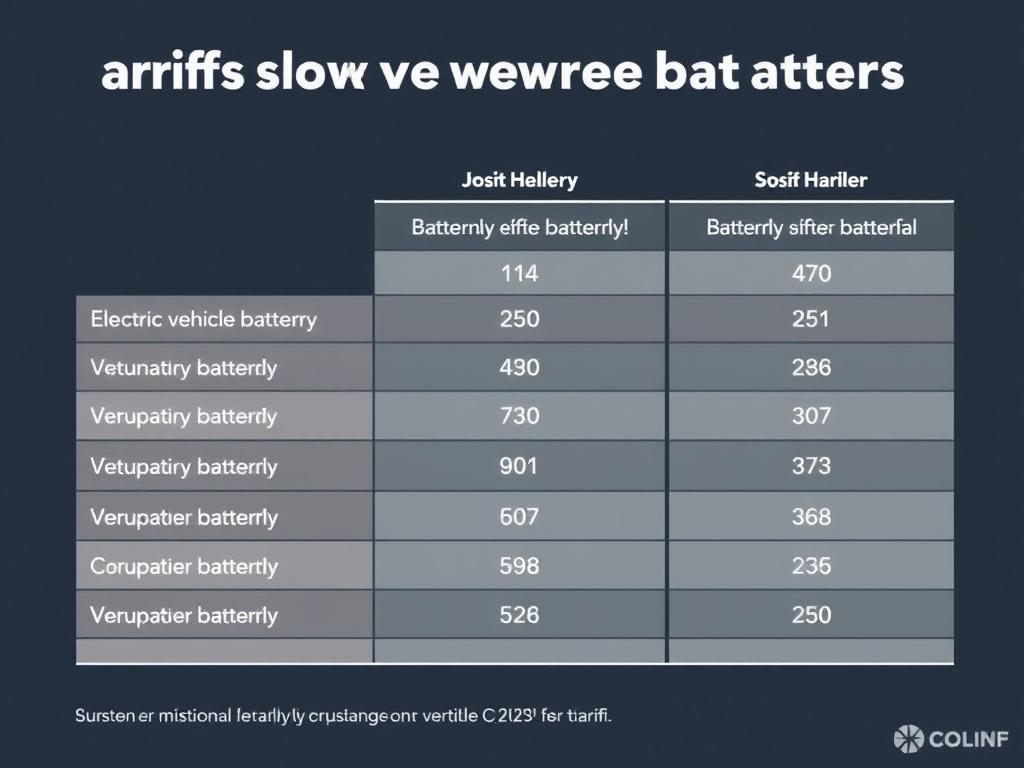
The following table outlines three hypothetical tariff designs and their likely short-term effects. These are illustrative, not predictive.
| Tariff type | Primary effect | Risk |
|---|---|---|
| Ad valorem percentage | Scales with price, protects across the board | May distort innovation toward cheaper, lower-quality cells |
| Specific kWh levy | Clear per-unit cost increase, predictable per vehicle | Penalizes higher-capacity cells and can bias chemistry choices |
| Temporary phased duty | Provides short-term shelter while capacity builds | Requires clear exit strategy to avoid entrenchment |
Public opinion and political economy
Public support for measures that keep jobs local is often strong, but voters also care about vehicle affordability and climate goals. Politicians therefore weigh visible job gains against less visible price increases that may reduce adoption of cleaner vehicles.
Lobbying from incumbent industries and new entrants shapes the political landscape. Legacy automakers may favor predictable, phased policies, while smaller suppliers might press for stronger protection. Transparency in policy objectives reduces the risk of capture by narrow interests.
Effective communication about why measures are temporary, how they support long-term affordability, and how they fit within climate targets helps build durable political consensus.
International cooperation as a force multiplier
Some goals—such as setting environmental standards, coordinating recycling rules, and jointly financing critical mineral projects—are better achieved through cooperation than unilateral tariffs. Multilateral arrangements can reduce the risk of trade wars while promoting shared norms.
Cooperation can also attenuate the need for extreme protection. For example, an alliance that pools demand for sustainably produced cells can create scale and pull investment into cleaner manufacturing without resorting to heavy duties.
Where strategic competition is high, selective partnerships with like-minded countries can create resilient supply corridors that lower the need for protectionist measures and maintain market access.
How to measure success
Success metrics for any battery trade policy should be clear and quantitative. Examples include the share of domestic cell production, reductions in lifecycle greenhouse gas intensity, levels of domestic recycling capacity, and the number of skilled jobs created.
Policymakers should set review points and adjust policies based on outcomes. Built-in sunset clauses, reporting requirements, and independent evaluation reduce the chance that temporary measures become permanent distortions.
Ultimately, the best measures are those that increase domestic capacity while reducing long-term costs and emissions—policies that create sustainable competitiveness, not perpetual shielding.
Personal perspective from industry conversations
In conversations with procurement managers and engineers, a recurring theme is the desire for predictability. Firms prefer clear timelines for policy changes so they can plan multiyear investments in plants and tooling.
Manufacturing leaders also emphasize skills and supplier ecosystems. A factory without a local cluster of component suppliers struggles to reach competitive output. Tariffs may attract a headline plant, but the broader ecosystem requires coordinated investment in smaller suppliers and logistics.
Those industry perspectives suggest that successful policy blends carrots and short, firm sticks: support to build clusters plus temporary protection that has an explicit exit path.
What to watch next
Watch for policy signals—legislative proposals, procurement rules, and international negotiations—that indicate a country’s willingness to deploy tariffs or alternative instruments. Also monitor investment announcements for new plants and recycling facilities; private capital often moves faster than public policy.
Technological shifts matter too. Breakthroughs in solid-state batteries, chemistry substitutions that reduce reliance on scarce metals, or major improvements in recycling technology could change the calculus for tariffs and local production.
Finally, keep an eye on commodity markets. Price shocks in lithium, nickel, or cobalt can rapidly alter trade flows and the political attractiveness of tariffs aimed at insulating domestic industry from volatility.
A pragmatic way forward
Tariffs on battery cells offer a tempting lever for countries seeking industrial renewal, climate action, or security. But they are blunt and carry real economic, diplomatic, and environmental trade-offs. Smart policy uses them sparingly, ties them to clear, temporary objectives, and combines them with incentives, skills programs, and recycling mandates.
In the years ahead, the most successful economies will be those that create predictable environments for investment, build the ecosystems that sustain manufacturing, and work with partners to reduce global bottlenecks. That path reduces the need for heavy-handed protection while delivering resilient, low-carbon battery supply chains that serve both industry and society.