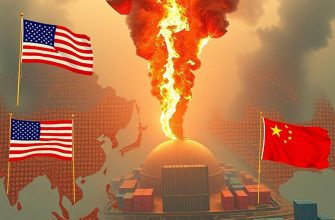
The headline question — Who won the US-China trade war? (Probably nobody) — captures the instinct many of us felt as tariffs rose, headlines multiplied, and politicians celebrated victories that didn’t quite add up when grocery bills and factory orders arrived. The clash between the world’s two largest economies was pitched as a fight for fair trade, intellectual property, and national security, but the immediate results were messy, diffuse, and often counterintuitive.
This article unpacks the trade war’s origins, the mechanics of tariffs and retaliation, the measurable economic impacts, and the longer, subtler shifts in supply chains and geopolitics. I’ll weigh claims of winners and losers across industries and countries, and explain why the blunt instrument of tariffs rarely produces a clean, decisive victory.
- How the trade war began: a short primer
- Timeline and mechanics: what actually happened
- How tariffs work in practice
- Immediate economic impacts: winners and losers
- How much did it slow growth? what the economic evidence says
- Who paid the tariffs? the distribution of costs
- Supply chains and trade diversion: the quiet rearrangement
- Technology, sanctions, and selective decoupling
- Real-life business responses: examples from the field
- Case study: agriculture and soybean markets
- Case study: consumer electronics and tariff pass-through
- Global effects: third countries and trade patterns
- Political and diplomatic consequences
- Measuring “victory”: what would winning even mean?
- Who could plausibly claim victory?
- How tariffs compare to other tools
- Table: quick matrix of gains and losses
- Financial markets and investor reactions
- Lessons for businesses: resilience and flexibility
- Long-term consequences: structural shifts and strategic thinking
- What policymakers could have done differently
- How ordinary people experienced the trade war
- Looking ahead: is a new form of rivalry inevitable?
- Final thoughts: why the answer is probably nobody
- What to watch next
How the trade war began: a short primer
The trade confrontation that escalated in 2018 did not appear from nowhere. It followed years of complaints in Washington about intellectual property theft, forced technology transfer, and a growing U.S. trade deficit with China. President Trump’s administration chose tariffs and the threat of tariffs as the principal tools to change Beijing’s behavior and rebalance trade relationships.
Tariffs are taxes on imports. By taxing Chinese goods, the U.S. hoped to make Chinese exports less competitive in American markets, push companies to shift production, and extract concessions in negotiations. China responded with retaliatory tariffs, hitting U.S. agricultural products, automobiles, and other sectors to pressure politically sensitive constituencies.
Timeline and mechanics: what actually happened
The rounds of tariffs unfolded over 2018 and 2019, with both sides targeting hundreds of billions of dollars in goods. Washington announced a succession of tariff lists, starting with steel and aluminum and expanding into electronics, machinery, and consumer goods. Beijing countered with lists aimed at farm states and manufacturing supply chains.
In January 2020 the two countries signed the Phase One agreement, which halted new tariff announcements and included commitments by China to buy more U.S. goods and to strengthen certain intellectual property protections. The deal left most tariffs in place and did not resolve large structural differences. When the COVID-19 pandemic hit weeks later, trade patterns shifted again and the promises in Phase One largely went unmet.
How tariffs work in practice
On paper, tariffs are simple: add a tax at the border, raise the cost of the imported good, and domestic producers gain a price advantage. In practice, the burden is shared and the effects ripple. Importers can absorb some of the tariff, exporters can lower prices, consumers can pay more, and supply chains can shift production locations.
For many products, the final consumer pays higher prices. For others, manufacturers reconfigure sourcing to avoid tariffs, moving production to countries not targeted by tariffs. Some firms simply accept smaller margins or delay investment. Economists emphasize that tariffs are a tax on the economy rather than a straightforward transfer from one nation to another.
Immediate economic impacts: winners and losers
When the dust settled on the most acute phase of the trade conflict, the short-run picture was messy. Certain exporters in China saw lower demand for targeted categories, and U.S. exporters faced reduced purchases from China. At the same time, some domestic industries in the U.S. that competed with Chinese imports gained breathing space.
But the gains were rarely large or durable. Tariffs on intermediate goods raised costs for U.S. manufacturers that relied on Chinese inputs. Farm communities, particularly soybean growers, bore a clear and politically visible cost from Chinese retaliation. Consumers across both countries felt impacts through higher prices and slower product rollouts.
How much did it slow growth? what the economic evidence says
Quantifying the trade war’s drag on GDP is challenging because it overlapped with other shocks, notably the COVID-19 pandemic. Still, most macroeconomic estimates show that tariffs were a real headwind, shaving growth in both economies and altering trade flows globally. The U.S. experienced a modest hit to consumption and investment, while China had a slowdown in export-led sectors.
Beyond headline GDP, there were measurable reallocations: manufacturing investment diverted to other countries, inventories adjusted, and business confidence fell during peak uncertainty. Those shifts often have persistent effects even after headline numbers stabilize, because capital and labor decisions take time to reverse.
Who paid the tariffs? the distribution of costs
When a tariff is imposed, three groups can share the cost: foreign exporters (through lower prices or lost sales), domestic importers (who may accept lower margins), or consumers (through higher retail prices). The split depends on market structure, product substitutability, and bargaining power. For many consumer goods, American buyers absorbed a significant share of the tariff burden.
For agricultural goods, Chinese retaliatory tariffs targeted crops like soybeans, where the U.S. had few nearby buyers ready to absorb excess supply. That concentrated harm among American farmers, a group that received emergency federal aid to offset losses. The aid mitigated some short-term pain but did not erase long-term market shifts toward other suppliers.
Supply chains and trade diversion: the quiet rearrangement
One of the trade war’s most durable effects was to accelerate supply-chain diversification. Firms that had concentrated production in China began moving factories or sourcing components from Vietnam, Mexico, India, and elsewhere. This didn’t happen overnight, but tariff risk made supply chains more elastic and encouraged geographic hedging.
Trade diversion meant China lost market share in some sectors, but it also deepened economic ties with other Asian nations. Meanwhile, some high-skill and capital-intensive manufacturing remained in China because of existing clusters, supplier ecosystems, and scale economies that could not be replicated quickly elsewhere.
Technology, sanctions, and selective decoupling
The trade war merged with national security concerns, especially in technology. The U.S. restricted sales of advanced semiconductors and banned certain Chinese telecom firms from American markets. Those actions were different in kind from tariffs, aiming to keep sensitive technologies out of rival hands.
These measures accelerated what analysts call strategic decoupling in critical tech sectors. Companies that rely on high-end chips, software, or secure supply lines now face compliance, retooling, and investment choices that will reshape innovation networks over the coming decade.
Real-life business responses: examples from the field
I spoke with managers in mid-sized manufacturing firms who described pragmatic responses: inventory buildup ahead of tariff deadlines, shifting suppliers to Southeast Asia, and pricing strategies to smooth cost shocks. Those conversations revealed a common theme — businesses adapted rather than collapsed, but adaptation had costs and created new dependencies.
For multinational firms, the calculus varied by industry. Electronics companies moved some assembly out of China but retained critical R&D and high-value production there. Apparel and low-margin consumer goods were easier to shift, leading to increased production in Cambodia, Bangladesh, and Vietnam.
Case study: agriculture and soybean markets
American soybean farmers were among the most visible casualties. Historically reliant on China as a major buyer, they faced abrupt demand reductions when Beijing imposed retaliatory tariffs. Exporters scrambled to find other customers, and prices fell in 2018 and 2019.
The U.S. government provided direct payments to farms through the Market Facilitation Program to offset losses. Those subsidies helped cushion incomes but could not restore pre-conflict trade patterns. Importantly, China diversified its purchases to Brazil and other suppliers, creating longer-term buyer-seller shifts.
Case study: consumer electronics and tariff pass-through
Consumer electronics illuminate how tariffs reach shoppers. Many components for phones and laptops are produced across a complex network; a tariff on finished goods or parts raises costs at multiple points. Retailers often absorbed some of the shock initially but then passed higher prices along to consumers through sticker-price increases or delayed product updates.
In other cases, manufacturers changed product specifications to use untaxed components or moved final assembly to avoid tariffs. These technical adjustments were costly but effective in many product lines — another reason clear winners were rare.
Global effects: third countries and trade patterns
The trade war reverberated beyond the U.S. and China. Middle powers and emerging economies benefited from trade diversion, selling more goods to China or the U.S. as supply chains shifted. Conversely, global trade growth slowed as uncertainty encouraged firms to invest less and reconsider long-distance sourcing.
Trade diversion isn’t free. New suppliers often require investment in logistics, quality control, and worker training. Countries like Vietnam and Mexico gained manufacturing activity, but they also absorbed the environmental, infrastructural, and social costs that accompany rapid industrial growth.
Political and diplomatic consequences
Domestically, the trade war had mixed political payoffs. Politicians could point to tariffs as tough action, but voters felt the consequences in pocketbooks and local economies. In swing states with large manufacturing or farm footprints, the backlash was palpable and complicated electoral narratives.
On the diplomatic front, the dispute hardened positions. China accelerated efforts to reduce dependence on Western tech and floated regional and global initiatives to deepen strategic autonomy. The trade conflict also pushed allies and partners to weigh their own policies amid rising U.S.-China rivalry.
Measuring “victory”: what would winning even mean?
To declare a victor in a trade confrontation, we need clear, measurable goals and outcomes. Was success defined as reduced intellectual property theft, a lower trade deficit, increased domestic production, or political leverage? Different stakeholders had different benchmarks, and tariffs mostly influenced only a subset of those objectives.
Many of the trade war’s stated aims — structural legal changes in China, sweeping limits on forced technology transfer, and durable shifts in global market access — remain only partially addressed. The Phase One agreement contained some commitments but fell short of comprehensive structural reform.
Who could plausibly claim victory?
Some groups fared better than others. Certain U.S. manufacturers protected from Chinese competition gained market share and breathing room. Countries that absorbed redirected supply chains saw increased exports. Politicians could tout short-term wins or tough negotiating stances. But these pockets of gain were offset by broader economic and political costs.
China also avoided catastrophic losses. Its economy adapted, internal demand policies cushioned export declines, and it expanded trade relationships elsewhere. Beijing paid costs but preserved long-term industrial policy goals. That resilience makes it hard to label China a clear loser.
How tariffs compare to other tools
Tariffs are blunt instruments. They can increase pressure, but they rarely produce complex institutional reforms like changes to corporate governance, legal systems, or enforcement regimes. Those kinds of changes typically require negotiation, lawmaking, and long-term engagement rather than purely economic pain.
Sanctions, export controls, and targeted investment restrictions can be more precise, especially when tied to national security concerns. Yet precision brings complexity and risk of escalation. Policymakers must balance the desire to punish against the need to preserve essential trade and innovation ties.
Table: quick matrix of gains and losses
| Group | Short-term effect | Longer-term outlook |
|---|---|---|
| U.S. consumers | Higher prices on many imports | Some substitution; persistent cost for some goods |
| U.S. farmers | Significant losses from retaliation | Some market loss to other suppliers |
| U.S. manufacturers | Mixed: protected in some sectors, hurt by input costs in others | Reshaping of supply chains and potential competitiveness gains |
| Chinese exporters | Lost sales in targeted categories; adjusted prices | Reorientation toward other markets and domestic demand |
| Third-country suppliers (Vietnam, Mexico) | Gained factory orders and investment | Infrastructure and labor-market pressures; possible consolidation |
Financial markets and investor reactions
Equity markets responded to tariff escalations with volatility. Uncertainty about tariffs and retaliations depressed investor sentiment and raised the cost of capital for some firms. Bond markets briefly reflected a flight to safety during acute standoffs, and currency markets adjusted as capital sought stability.
Investors also redirected capital into countries expected to benefit from trade diversion. Private equity and multinational corporations increased scrutiny of exposure to tariff risk and regulatory entanglements, often favoring diversification over reconcentration.
Lessons for businesses: resilience and flexibility
One clear lesson from the trade war is that resilience matters. Firms with diversified suppliers and flexible logistics fared better than those locked into single-country dependencies. Inventory management, contractual agility, and scenario planning became priorities in corporate risk management.
At the same time, resilience is costly. Building parallel supply lines or investing in new facilities requires capital and managerial attention. Smaller firms often lacked the resources to adapt swiftly, making them more vulnerable to trade-policy shocks.
Long-term consequences: structural shifts and strategic thinking
Beyond immediate price effects, the trade war nudged global economic structures. Countries and companies accelerated technology self-reliance programs, diversified supply chains, and updated risk assessments. These shifts take years to play out but can alter the competitive landscape for decades.
Educational and workforce policies will matter too. If manufacturing and high-tech investment relocates more broadly, countries with skilled labor and supportive ecosystems will capture more value. That reality elevates questions about industrial policy and long-run comparative advantage.
What policymakers could have done differently
Hindsight suggests several alternative approaches. Targeted, multilateral actions — backed by solid evidence and allied cooperation — might have exerted pressure without broad consumer costs. Negotiated frameworks with stronger enforcement mechanisms could have traded leverage for clearer commitments.
Domestically, more aggressive support for workers and communities affected by import competition could have reduced political backlash and smoothed transitions. Trade adjustment assistance and retraining programs are slow to act but can reduce long-term social costs when well designed.
How ordinary people experienced the trade war
For many Americans, the trade war was not an abstract policy debate but a series of small losses: a more expensive appliance, an agricultural neighbor who struggled with cash flow, or a factory whose orders slowed. Those micro-level impacts added up, shaping sentiment in communities dependent on trade-exposed industries.
In China, household concerns centered on job security in export-oriented cities and the broader sense of economic uncertainty. Consumers there saw selective price effects and the government’s pivot to domestic consumption as a stabilizer.
Looking ahead: is a new form of rivalry inevitable?
The trade war did not produce a decisive victor, but it did harden a pattern of strategic rivalry. Future policy debates will likely balance economic openness with national security considerations, creating a hybrid framework that is neither full embrace nor complete isolation. That hybrid is the new normal for global economic policy.
Investment in secure supply chains, domestic manufacturing where strategically necessary, and multilateral cooperation on trade rules will shape the coming decade. Those moves can mitigate future shocks, but they also reflect a recalibration of globalization rather than its wholesale reversal.
Final thoughts: why the answer is probably nobody
When we ask, Who won the US-China trade war? (Probably nobody), the phrase is shorthand for a deeper truth: tariffs redistributed pain and opportunity in ways that produced few clear, durable winners. Political theater and short-run gains masked structural shifts that neither side fully controlled.
The real outcomes were layered and mixed. Some industries and countries captured opportunities from reconfigured supply chains. Some firms and workers were hurt. Both countries endured costs, and global trade patterns became more complex. Victory in such an environment looks less like a trophy and more like a long, costly process of adjustment.
What to watch next
Future indicators to watch include investment patterns in semiconductors, changes in global trade agreements, and the extent to which firms commit to permanent diversification. Also important are the legal and institutional changes China might enact to address foreign complaints, and whether the U.S. builds durable alliances to tackle shared trade concerns.
Ultimately, the trade war’s legacy will be judged not by a single headline but by how nations, companies, and communities adapt. The lesson is that economic policy needs subtlety, credibility, and support systems for those harmed in the short term if it is to produce lasting change.