The semiconductor tariff war between US and China has turned what used to be a niche trade policy debate into a geopolitical drama with far-reaching consequences. Chips power everything from phones to jets, and the moves Washington and Beijing take now will shape technology, supply chains, and strategic balances for years to come.
This article walks through the origins of the dispute, the specific measures that have been imposed, how companies and other nations are reacting, and what plausible futures might look like. I’ll draw on reporting, policy documents, and conversations I’ve had with engineers and supply-chain managers to give a practical, grounded view of what’s at stake.
- Why semiconductors matter more than ever
- Background: from trade frictions to targeted tech controls
- Key drivers behind the policy shift
- Timeline of major actions and announcements
- How the measures work: tariffs, export controls, and investment screening
- Why targeted controls can be more disruptive than tariffs
- Supply-chain shocks and corporate reactions
- Reshoring, friend-shoring, and fragmentation
- Economic consequences for the United States
- Economic consequences for China
- Political economy inside China
- National security: real trade-offs and ambiguous boundaries
- Risk of accelerating decoupling
- How other countries are responding
- Multilateral vs unilateral approaches
- Corporate strategies: adaptation, innovation, and hedging
- Case study: an OEM’s pragmatic pivot
- Innovation consequences: risk and opportunity
- Scenarios for the next five to ten years
- Policy options and trade-offs for governments
- Practical advice for businesses navigating the dispute
- Personal reflections from the front lines
- What consumers and investors should watch
- Toward workable cooperation on a contested field
Why semiconductors matter more than ever
Semiconductors are the functional heart of modern electronics: microprocessors, memory chips, sensors, and custom ASICs enable digital services, artificial intelligence, and advanced manufacturing. They’re not just components; they are the performance and security bedrock for industries ranging from healthcare to defense.
As devices have become smarter and software-hungry, demand for advanced nodes—that is, chips with smaller, more efficient transistors—has soared. National competitiveness increasingly tracks with semiconductor capability because leadership here enables downstream innovation across entire economies.
Background: from trade frictions to targeted tech controls
Trade tensions between the United States and China predate the current chip dispute, but the focus on semiconductors reflects a shift from tariff-heavy trade wars to toolkits that include export controls, entity lists, and investment screening. These instruments aim to curb technology transfer as much as to alter trade balances.
Both countries built deep specialization: the U.S. dominates chip design and many advanced tools, Taiwan and South Korea lead in manufacturing, and China has strong capacity in assembly, testing, and mature-node production. That interdependence makes blunt measures risky, which partly explains the mix of tariffs and targeted restrictions we see.
Key drivers behind the policy shift
National security concerns—especially about advanced computing for military applications—have pushed policymakers to treat chips as strategic assets rather than mere trade goods. This has justified measures meant to slow a rival’s access to cutting-edge capabilities.
At the same time, industrial policy ambitions in China, such as self-sufficiency goals in the semiconductor sector, have clashed with U.S. efforts to maintain technological advantage. The result is a contest that blends economics, diplomacy, and technology policy.
Timeline of major actions and announcements
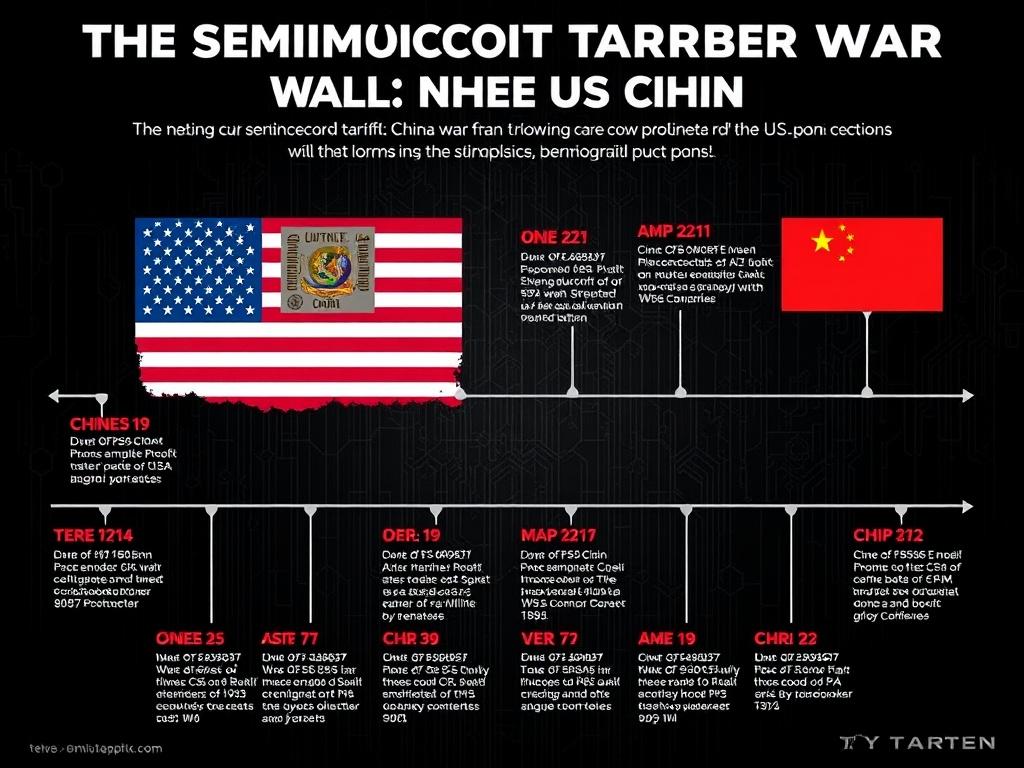
Understanding how we arrived here requires a timeline of key steps taken by both sides over the last several years. Below is a condensed table of notable measures and turning points.
| Year | Action | Significance |
|---|---|---|
| 2018–2019 | Tariffs and initial entity list placements | Broader trade tensions escalate; early technology-targeted controls begin. |
| 2020 | U.S. restrictions on Huawei and selected entities | First major export-control campaign targeting telecom and semiconductor access. |
| 2021–2022 | Expanded export controls and restrictions on chipmaking equipment | Moves aimed at limiting China’s access to advanced nodes and fabrication tools. |
| 2022–2023 | Chinese incentives and domestic investment pushes | China accelerates subsidies and R&D to reduce reliance on foreign tech. |
| 2023–2024 | Reciprocal measures and supply-chain diversification efforts | Companies and governments begin reshoring, friend-shoring, and alternative sourcing. |
This table simplifies a complex, evolving sequence of policy moves, but it captures the arc from tariffs and trade spats to sophisticated export controls and countermeasures that target specific layers of the semiconductor value chain.
How the measures work: tariffs, export controls, and investment screening
Tariffs are blunt instruments that raise the cost of imported goods, and they were among the first steps in the broader U.S.-China trade standoff. But when it comes to semiconductors, policymakers have added more surgical tools to their toolkit.
Export controls restrict the sale of certain technologies or equipment to specified entities. They can be immediate and precise: a particular design software, a piece of lithography equipment, or a packaging tool can be placed under licensing requirements or outright bans.
Investment screening and entity lists prevent foreign access to sensitive technologies via acquisitions or partnerships. These rules can be used to block foreign purchases of semiconductor firms, or require licensing for joint ventures in areas deemed critical to national security.
Why targeted controls can be more disruptive than tariffs
Targeted controls often hit critical nodes in the supply chain that have outsized impact. Denying access to extreme ultraviolet (EUV) lithography tools, for example, can constrain a country’s ability to make the most advanced chips far more than a nominal tariff would.
Because supply chains are globally distributed and specialized, blocking one crucial input forces cascading adjustments—new suppliers must be found, production redesigned, or product roadmaps altered. That complexity makes the impact both technical and strategic.
Supply-chain shocks and corporate reactions
Companies facing shifting rules react in several ways: diversifying suppliers, relocating capacity, stockpiling components, and redesigning chips to rely on less-restricted technologies. These strategies are pragmatic responses to policy risk.
I’ve spoken with procurement teams at major OEMs who told me that contingency planning is now baked into quarterly reviews. Firms that once assumed smooth cross-border flows now model multiple disruption scenarios and build redundancy into their sourcing and inventory practices.
Reshoring, friend-shoring, and fragmentation
Policymakers favor reshoring or “friend-shoring” to reduce reliance on adversarial states. That leads to new investments in fabs in allied countries, subsidies for domestic manufacturing, and closer industrial cooperation among partners.
While these moves strengthen certain supply-chain segments, they also fragment global production. Fragmentation can raise costs and slow innovation because it reduces the scale efficiencies and tacit knowledge that come from tightly integrated ecosystems.
Economic consequences for the United States
The U.S. strategy aims to protect leadership in chip design and critical tools, and to maintain a secure supply for defense. Short-term costs include higher prices for some electronics and disruption for firms dependent on Chinese manufacturing and markets.
Longer-term benefits depend on successful industrial policy: if U.S. subsidies, workforce development, and partnerships spur domestic expansion of advanced fabrication, the economy could gain high-value jobs and secure technology pathways.
Economic consequences for China
China faces both immediate pain and long-term incentives. Restrictions on its access to advanced chips and equipment slow progress in areas such as high-end AI processors and certain types of ML inference hardware. That hampers some civilian and military applications.
At the same time, these restrictions have galvanized large state-backed investments in domestic capability. China’s strategy emphasizes vertical integration—moving up the stack from assembly toward design and fabrication—to reduce exposure to foreign controls.
Political economy inside China
The Chinese government has responded with subsidies, tax incentives, and national champions meant to accelerate semiconductor self-sufficiency. This creates winners and losers domestically: favored firms gain capital, while others face consolidation pressure.
Those interventions can produce rapid capacity growth in mature nodes and packaging, but replicating cutting-edge lithography and sophisticated design ecosystems is a multiyear, expensive endeavor with uncertain returns.
National security: real trade-offs and ambiguous boundaries
National security arguments for restrictions are compelling on the surface: advanced chips can enable missile guidance, secure communications, and powerful AI systems. Policymakers argue that keeping certain capabilities out of adversaries’ hands preserves a strategic edge.
But the boundary between civilian and military use is blurry in semiconductors. Dual-use applications mean that controls can delay civilian innovation and generate friction with allies who need the same technologies for benign purposes.
Risk of accelerating decoupling
As the U.S. and China erect barriers, global technology ecosystems risk diverging. Divergence increases costs, complicates standards, and may foster parallel innovation tracks that impede global collaboration on security and safety issues.
This decoupling can also create new vulnerabilities: for instance, if each side becomes reliant on its own suppliers, systemic failures or quality differences could produce unexpected fragility in global infrastructure.
How other countries are responding
Allies and partners are choosing sides with nuance. Some European countries have joined U.S. export-control efforts while also maintaining trade ties with China. East Asian suppliers are expanding capacity but balancing customer relationships carefully.
Japan, South Korea, the Netherlands, and Taiwan are particularly important because of their roles in equipment and manufacturing. Those countries face diplomatic pressure as they must weigh economic interests against security partnerships.
Multilateral vs unilateral approaches
Multilateral coordination on export controls tends to be more effective, because it reduces the space for target countries to simply buy restricted goods elsewhere. But aligning diverse national interests is hard, and unilateral measures remain common.
Policy harmonization is more likely on narrow items—like specific lithography tools—than on broader categories. Expect patchwork regimes that evolve gradually, driven by diplomatic negotiations and shared intelligence assessments.
Corporate strategies: adaptation, innovation, and hedging
Firms are responding with a mix of tactics. Chipmakers are investing in geographically diversified fabs and signing long-term supply agreements. Designers are creating alternative versions of chips that use less restricted parts or older process nodes.
Some firms increase stockpiles of critical inputs; others accelerate R&D in domestic toolchains or partner with friendly suppliers to secure continuity. For many companies, agility and regulatory foresight are now core competencies.
Case study: an OEM’s pragmatic pivot
At a large consumer electronics firm I visited, engineers were redesigning a flagship product to use a different memory vendor after a supplier faced export restrictions. The change cost months of validation but preserved product launches and market share.
That example shows how firms trade time and development expense for market continuity. Companies with flexible architectures and strong supplier relationships fare better than those locked into single-source dependencies.
Innovation consequences: risk and opportunity
Restrictions can slow the diffusion of cutting-edge tools and ideas, but they can also spur localized innovation. If Chinese firms can’t buy certain equipment, they may invest in domestic alternatives—or prioritize software and architecture to extract more from available hardware.
The net effect on global innovation depends on whether the added costs and duplication lead to parallel progress or wasteful redundancy. History suggests both outcomes are possible, and outcomes will vary by technology domain.
Scenarios for the next five to ten years
Scenario one: managed competition. The U.S., allies, and China find a begrudging equilibrium through targeted controls, selective partnerships, and partial supply-chain decoupling. Costs rise but catastrophic disruptions are avoided.
Scenario two: deep decoupling. Restrictions broaden and investment incentives harden, producing two fairly separate technology ecosystems. This would push up costs, slow some innovation, and complicate global standards and interoperability.
Scenario three: détente and market-led integration. Diplomatic progress and market forces reduce restrictions, leading to renewed integration and efficiency. This is possible but currently seems less likely given strategic distrust and domestic political pressures on both sides.
Policy options and trade-offs for governments

Policymakers must balance security concerns with economic efficiency and innovation incentives. Options include carefully calibrated export controls, investment in domestic R&D and fabs, forming secure supply arrangements with allies, and selective openness for benign technology transfer.
Each choice comes with trade-offs: tighter controls increase supply risk and costs, while too much openness risks unintended technology transfer. Effective policy mixes will likely be iterative and responsive to technological change.
- Strengthen targeted export controls while coordinating with allies to close loopholes.
- Subsidize domestic manufacturing and workforce development without creating perpetual dependence on state aid.
- Create secure “trusted” supply corridors for critical components among allied countries.
- Invest in standards and verification to reduce ambiguity over dual-use technologies.
Practical advice for businesses navigating the dispute
Companies should perform detailed exposure mapping: know which parts, suppliers, and customers would be affected by different restriction scenarios. That clarity drives smarter contingency plans and targeted investments.
Build flexible product architectures where feasible, and cultivate multiple qualified suppliers for critical components. Long-term contracts and joint development agreements with trusted partners can reduce volatility.
Finally, maintain active policy engagement through industry associations so that regulations reflect operational realities and to ensure your firm’s voice informs the design of practical, enforceable rules.
Personal reflections from the front lines
Over the past three years I’ve attended workshops where chip designers, policy analysts, and procurement directors traded candid assessments of risk. The shared theme was a new normal: strategic thinking is now a routine part of engineering calendars and boardroom discussions.
One productive conversation I remember involved a small design house that pivoted to specialized AI accelerators optimized for less advanced nodes. They found market niches by reimagining performance trade-offs rather than chasing cutting-edge processes they couldn’t access.
What consumers and investors should watch
Consumers will feel effects unevenly: some product categories may see modest price increases, while enterprise and defense sectors could face supply constraints for specialized components. Investors should watch capacity expansions, toolmakers’ patent portfolios, and policy developments that affect cross-border deals.
Key indicators include fab investment announcements, export-control updates, and diplomatic alignments among leading equipment suppliers. These signals will help anticipate disruptions and opportunities in chip-related markets.
Toward workable cooperation on a contested field
The semiconductor dispute illustrates a broader problem in contemporary geopolitics: technologies that are economically interwoven become strategic chess pieces. That complicates both competition and cooperation, because the consequences of misstep are wide.
Finding pragmatic frameworks—limited, enforceable rules about what must remain off-limits, paired with channels to keep benign cooperation alive—would reduce the worst economic costs while addressing legitimate security concerns. Achieving that balance requires realism, patience, and technical precision from policymakers and industry alike.
The semiconductor tariff war between US and China has already reshaped corporate strategies, national policies, and global supply chains. Whether the result is managed competition or deeper fragmentation depends on decisions made in the next several years by governments, firms, and technical communities.
For now, companies that prepare, diversify, and innovate within constraints will be best positioned to navigate the turbulence ahead. The stakes are high not only for markets and profits, but for the technological foundations of our societies.