Trade barriers shape the price tags we see in stores, the factories we pass on road trips, and the strategies companies use to reach customers abroad. If you have ever wondered what a “trade barrier” actually means and why tariffs are the most common one, this article walks through the tools, motives, and consequences so the topic feels less like jargon and more like everyday economic policy.
- Defining trade barriers: more than just a wall at the border
- Why policymakers use trade barriers
- The main types of trade barriers
- Tariffs
- Quotas
- Subsidies and countervailing duties
- Technical barriers and standards
- Customs procedures and administrative barriers
- Tariffs in detail: how they work and how they vary
- Why tariffs are the most common trade barrier
- The economic effects of tariffs
- Tariffs, terms of trade, and strategic considerations
- Non-tariff barriers and the shift in modern trade policy
- Comparing tariffs and non-tariff barriers
- Historical episodes: when tariffs dominated the agenda
- Legal frameworks: where tariffs sit in international law
- How businesses adapt to tariffs
- Rules of origin and preferences: complicating factors
- Political economy: winners, losers, and lobbying
- Measuring the impact of trade barriers
- When might tariffs be justified?
- Tariffs and inequality: distributional consequences
- The rise of supply chain diplomacy
- Alternatives to tariffs for protecting domestic industries
- Practical advice for consumers and small businesses
- Looking forward: tariffs in a connected world
- Final thoughts on what a “trade barrier” is and why tariffs lead the list
Defining trade barriers: more than just a wall at the border
A trade barrier is any government policy or official practice that makes cross-border trade more difficult, expensive, or uncertain. These measures can be overt—like a tax on imports—or subtle—such as complicated licensing requirements that slow shipments for weeks.
Trade barriers also include domestic policies that indirectly influence imports and exports. Examples range from rules that favor local suppliers to environmental standards that foreign firms struggle to meet.
Why policymakers use trade barriers
Governments apply trade barriers for practical and political reasons. Sometimes the goal is revenue; other times it’s to shield domestic industries from foreign competition while they grow stronger.
Political motives matter a great deal. Industries with concentrated interests—like steel mills or sugar producers—tend to lobby fiercely for protection, while the cost is spread thinly across millions of consumers who notice price changes less vividly.
The main types of trade barriers
Trade barriers come in a variety of forms, and economists group them into two broad buckets: tariffs and non-tariff barriers. Both can distort trade, but they do so in different ways and with different political dynamics.
This section will walk through the most common instruments so you can tell a tariff from a quota or a technical standard by sight.
Tariffs
Tariffs are taxes levied on imported goods, usually expressed as a percentage of the product’s value or as a specific amount per unit. They raise the import’s price in the domestic market and generate revenue for the government at the same time.
Because tariffs are easy to calculate and administer at customs points, they have long been the default tool for governments seeking both protection and income. Their visibility also makes them politically useful: voters and industrial groups see who benefits and who pays.
Quotas
Quotas limit the physical quantity of a good that can enter a country during a set period. By capping supply, quotas can push up domestic prices for the protected product and create scarcity rents for those holding import licenses.
Quota systems are less flexible than tariffs. They often require allocation mechanisms that can breed corruption or favoritism, and they are politically sensitive because they directly constrain foreign exporters’ market access.
Subsidies and countervailing duties
Subsidies are payments or tax breaks that governments give domestic industries to reduce their production costs. They make local products cheaper on both the domestic and international market, giving subsidized firms an advantage over foreign rivals.
Other countries may respond with countervailing duties—additional charges imposed to offset the advantage that subsidized foreign goods enjoy—turning one policy into a broader trade dispute.
Technical barriers and standards
Non-tariff barriers often hide inside technical regulations: safety rules, sanitary standards, and labeling requirements. These measures can be legitimate public-interest policies, but they can also act as discreet obstacles when they are more stringent than necessary or applied in a discriminatory way.
Standards become especially important for complex goods like electronics and food, where testing, certification, and compliance create real costs for foreign exporters trying to meet a host country’s rules.
Customs procedures and administrative barriers
Delays, paperwork, inspections, and opaque customs valuation practices can raise the time and cost of trading across borders. While not taxes in the conventional sense, these administrative barriers act like one by increasing the effective price of imports.
Smaller firms and new exporters often struggle most with administrative burdens, which is why many countries identify customs modernization as a priority to promote trade growth.
Tariffs in detail: how they work and how they vary
Tariffs come in a few common forms. Ad valorem tariffs charge a percentage of the value, specific tariffs levy a fixed fee per unit, and compound tariffs combine the two approaches. Each type affects pricing and protection differently.
Tariffs also differ by whether they are applied at the border or collected as part of domestic sales, and whether they are bound (capped) under international agreements or unbound and adjustable at national discretion.
Why tariffs are the most common trade barrier
Tariffs are ubiquitous because they hit several policy targets at once: they raise revenue, protect domestic producers, and are straightforward to implement. A single tariff schedule can be posted and enforced at customs without a complicated administrative apparatus.
Visibility is another factor. A tariff is a clear policy instrument; its costs show up on price tags or in public budgets, and that clarity can be politically useful. Politicians can advertise protection for local jobs while also pointing to tariff revenue as a source of government funds.
Economists also note that tariffs are easier to coordinate in trade negotiations. Countries can offer reciprocal reductions in formal tariff schedules, creating a transparent path to liberalization. Non-tariff measures, by contrast, are sometimes harder to quantify and negotiate away.
Finally, tariffs can be calibrated. Governments can adjust rates by product, impose temporary safeguard tariffs, or apply preferential tariffs for trade partners—flexibility that makes tariffs a go-to tool across very different policy objectives.
The economic effects of tariffs
Tariffs raise the domestic price of imported goods, which in turn distorts consumption and production decisions. Consumers pay more, domestic producers earn higher prices and market share, and the government collects revenue.
From an efficiency standpoint, tariffs create deadweight losses: some trades that would have occurred without the tariff no longer happen, and resources are misallocated toward less efficient domestic production. The net effect on national welfare depends on the tariff’s size and the market structure.
Tariffs can also trigger retaliation. If trading partners respond with their own tariffs, exports suffer and global value chains face disruption. When retaliation escalates, entire sectors can experience higher costs and lost demand.
Tariffs, terms of trade, and strategic considerations
The “terms of trade” argument suggests a large country could improve its welfare by imposing tariffs if it manages to lower the world price of imports. In practice, this strategic advantage is limited and risky. It often invites retaliation and reduces international cooperation.
Smaller economies rarely benefit from unilateral tariffs in the long run, because their leverage in world markets is limited and the domestic distortions tend to outweigh any marginal terms-of-trade gains. Political and distributional motives, rather than textbook efficiency calculations, more often explain tariff policy.
Non-tariff barriers and the shift in modern trade policy
As global tariff rates have fallen through successive negotiation rounds, non-tariff barriers have become more prominent. Firms now face regulatory diversity and rules-of-origin clauses that affect where they manufacture and source parts.
Non-tariff measures are often more subtle and harder to quantify, which allows countries to achieve protectionist ends without the straightforward optics of a tariff. For this reason, trade negotiators spend much time on harmonizing standards and disciplines on regulatory transparency.
Comparing tariffs and non-tariff barriers
To see the contrasts clearly, consider a brief side-by-side comparison of tariffs and non-tariff measures. The table below summarizes the main differences in implementation, visibility, and economic impact.
| Feature | Tariffs | Non-tariff barriers |
|---|---|---|
| Visibility | High—taxes at customs are public and measurable | Low to medium—rules may be technical or administrative |
| Ease of administration | Relatively easy—single point of collection | Varies—can be complex and require agencies to enforce |
| Revenue for government | Direct revenue source | Indirect—revenue less common |
| Potential for discrimination | Low—applies broadly by tariff line | High—can be tailored to exclude specific countries |
| Negotiability in trade talks | High—tariff schedules are negotiable | Challenging—hard to quantify and enforce |
Historical episodes: when tariffs dominated the agenda
History offers stark examples of how tariffs shape economies and politics. The 1930 Smoot-Hawley tariff in the United States raised import duties across many categories and contributed to global trade contraction during the Great Depression.
More recently, in the late 2010s several countries imposed high-profile tariffs on steel, aluminum, and other goods for national security and industrial policy reasons. Those measures sparked disputes at the World Trade Organization and prompted retaliatory tariffs, illustrating how quickly tariff actions can ripple around the world.
These episodes show that tariffs are not merely abstract economic tools; they are instruments that interact with geopolitics, domestic politics, and global supply chains in tangible ways.
Legal frameworks: where tariffs sit in international law
The General Agreement on Tariffs and Trade (GATT) and its successor, the World Trade Organization (WTO), created rules that constrain how countries use tariffs. Under these rules, members bind tariff levels and agree on non-discriminatory treatment for foreign goods.
Still, the WTO allows exceptions. Temporary safeguard measures, anti-dumping duties, and countervailing duties provide legal cover for protective actions under specific circumstances. These exceptions partly explain why tariffs remain available tools despite broad trade liberalization efforts.
How businesses adapt to tariffs
When tariffs change, firms react quickly. They may alter pricing, shift sourcing to lower-cost suppliers, or relocate production to tariff-favored countries. Modern supply chains, with their fragmentation across borders, offer many levers for corporate response.
Companies often redesign products to meet foreign standards or split components across jurisdictions to exploit preferences under free trade agreements. In my own career working on a small export project, we found that a modest tariff increase made relocating final assembly across the border the only viable way to keep prices competitive.
Rules of origin and preferences: complicating factors
Preferential trade agreements reduce or eliminate tariffs for qualifying goods, but those benefits depend on rules of origin, which determine how much of the product must be made locally. Rules of origin can be as constraining as tariffs if they force firms to restructure production in inefficient ways.
Consequently, companies often invest in compliance, certification, and documentation to take advantage of lower tariffs under trade agreements. That administrative cost is another reason non-tariff barriers matter alongside headline tariff rates.
Political economy: winners, losers, and lobbying
Tariffs create concentrated winners—specific firms and workers who gain protection—and diffuse losers—consumers and downstream industries that pay higher prices. This asymmetry explains why protectionist policies persist even in the face of clear aggregate welfare losses.
Interest groups with concentrated stakes mobilize resources and political influence. They press lawmakers for continued protection, and politicians respond when local jobs and campaign contributions are at stake. The resulting policy mix often reflects political bargaining more than economic optimization.
Measuring the impact of trade barriers
Economists use several tools to measure trade barriers, including tariff equivalents for non-tariff measures and indexes that summarize a country’s overall trade restrictiveness. These measures help in comparisons and in modeling the likely impact of policy changes.
Empirical studies typically find that while tariffs have declined globally, the cumulative effect of non-tariff measures can be substantial—making comprehensive measurement essential for sound policy decisions.
When might tariffs be justified?
Certain arguments are commonly advanced in defense of tariffs: protecting infant industries, addressing national security concerns, or responding to unfair trade practices like dumping. Each argument has its caveats and requires careful evidence.
Infant industry protection can work in specific historical contexts where dynamic scale economies and learning-by-doing are crucial, but such policies must be temporary and well-targeted. Otherwise they risk creating sheltered industries that never become globally competitive.
Tariffs and inequality: distributional consequences
Tariffs tend to be regressive in the sense that they disproportionately affect lower-income consumers who spend a larger fraction of their income on goods. At the same time, tariff protection can preserve jobs in certain regions, creating complex distributional trade-offs.
Policymakers who use tariffs as part of an industrial strategy should weigh these distributional effects and consider complementary policies like retraining or direct transfers to affected workers.
The rise of supply chain diplomacy
In recent years, trade policy has increasingly focused on the resilience and security of supply chains. Tariffs are only one tool in a broader set of measures—including export controls and investment screening—that governments use to shape where critical goods are sourced and produced.
For multinational corporations, this trend means balancing cost efficiency against the risk of policy-induced disruptions. A factory built purely for low cost might face tariff penalties or restrictions that change its economic calculus overnight.
Alternatives to tariffs for protecting domestic industries
Instead of tariffs, governments can use time-limited subsidies, targeted tax credits, or public investment in worker training and technology to support strategic industries. These measures can be more transparent and less distortionary if designed well.
Trade policy also works through negotiation—bilateral and multilateral agreements that reduce tariffs and harmonize rules create more predictable environments for firms and governments alike, lowering the incentive to use blunt protective instruments.
Practical advice for consumers and small businesses
Consumers should expect price differences on imported goods when tariffs are in effect, and small businesses that export or import should track tariff changes closely. Flexibility in sourcing and understanding rules of origin can be critical competitive advantages.
For entrepreneurs, building relationships with customs brokers and investing in compliance systems can pay off. Those investments reduce the risk of costly delays or penalties when governments adjust trade policy.
Looking forward: tariffs in a connected world
Tariffs will likely remain part of the policy toolkit because of their simplicity, visibility, and the revenue they produce. But their role continues to evolve as trade negotiators focus on non-tariff disciplines and as geopolitical tensions push countries to think about supply chain security.
The future of trade policy will be shaped by technological change, shifting political coalitions, and practical concerns about resilience. Tariffs will sit alongside a wider set of measures, sometimes at the center of debates and sometimes as a quick lever governments reach for when confronting new shocks.
Final thoughts on what a “trade barrier” is and why tariffs lead the list
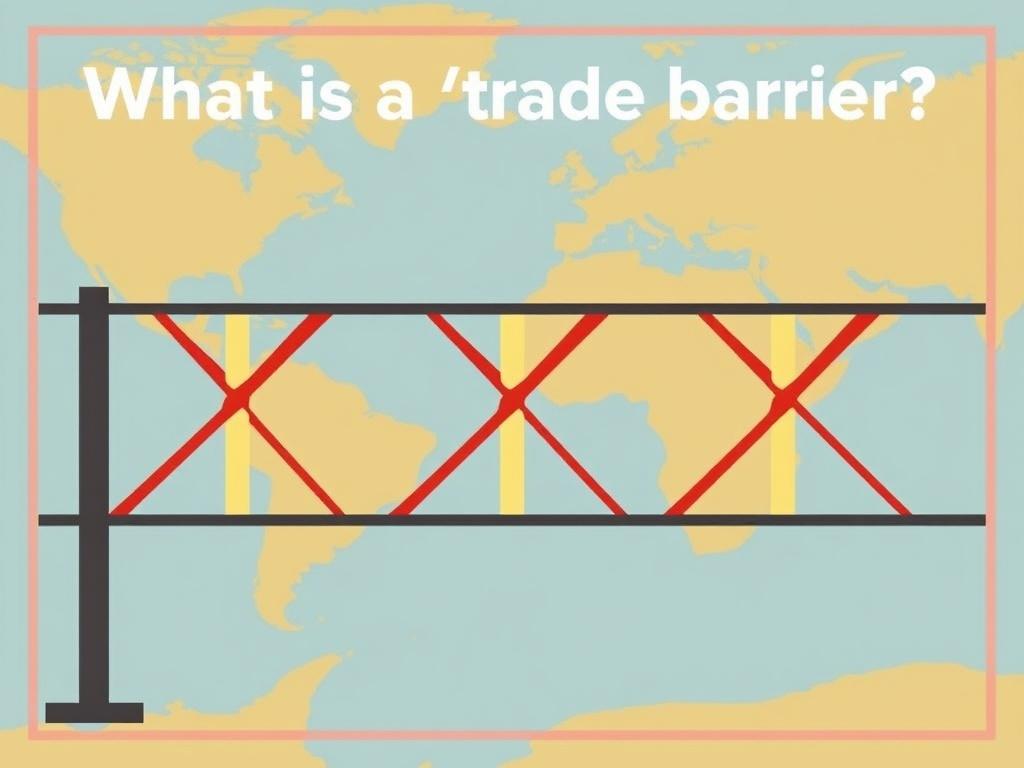
A trade barrier is any policy that changes the incentives for importing or exporting, and tariffs are the most common because they are simple, visible, and multifunctional—raising revenue while offering protection. Their political and administrative ease keeps them prominent even as other barriers become more sophisticated.
Understanding tariffs and the wider family of trade barriers helps citizens judge policy debates and helps businesses anticipate change. When tariffs are on the table, the ripple effects touch prices, investment decisions, and international relations alike, making trade policy a subject worth following closely.